Wednesday, March 06, 2024
The Dubrovnik Book Club by Eva Glyn
Wednesday, December 20, 2023
The Librarianist by Patrick deWitt
Wednesday, September 14, 2022
Remarkably Bright Creatures by Shelby Van Pelt
First Line: Day 1,299 of My Captivity. Darkness suits me.
Monday, December 27, 2021
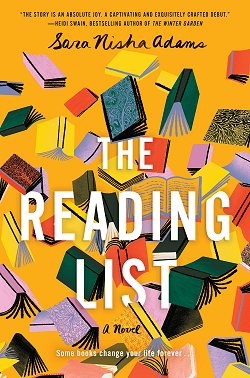
The Reading List by Sara Nisha Adams
Monday, November 15, 2021
Billy Summers by Stephen King
Wednesday, September 16, 2020
Dead Woman Driving: Dead in the Desert by Sue Ann Jaffarian
Hope Callahan is no stranger to living a rough life. She ran away from home as a teen and has often found herself on the wrong side of the law. Her latest boyfriend had dreams of becoming a drug lord, and as a result, Hope is badly beaten and left for dead in the Sonoran Desert south of Tucson. Fortunately, she's found by Ozzie Byrd, a scruffy-looking old guy traveling in an RV with his three-legged dog named Punch. Ozzie has his own criminal past, but he does give Hope a chance at a new life. The question is: will she grab this once-in-a-lifetime opportunity, or run from it, trying to stay alive on her own?
I'm no stranger to Sue Ann Jaffarian's writing, in particular her Odelia Grey mysteries. I've been following her on Facebook and vicariously enjoying her life. You see, Jaffarian retired from being a paralegal, bought an RV, and has been traveling the country, sharing her adventures in photos and prose along the way. When she mentioned her new serial novel Dead Woman Driving, I knew I had to read it.
I certainly wasn't disappointed. I was so engrossed in the story that the thirty-two pages flew by. Hope is going to be an interesting character. She's a good person, but since she's a graduate of the School of Hard Knocks, readers are never going to know what skills she has in her repertoire to confront anything her travels throw at her. Ozzie and his three-legged dog Punch were perfect companions for Hope.
Dead Woman Driving is going to be just the thing for readers who only have short periods of time in which to read. If each installment is around thirty pages, Jaffarian's intriguing storylines and well-developed characters are going to suck readers in and leave them waiting impatiently for the next installment. I know I am.
Dead Woman Driving: Dead in the Desert
ASIN: B08HR9JL4V
The Novel RV © 2020
eBook, 32 pages
Contemporary Fiction, #1 Dead Woman Driving
Rating: B+
Source: Purchased from Amazon.
Thursday, June 06, 2019
New Jerusalem News by John Enright
First Line: It was Brenda's idea.
Life as a professional houseguest is just what Dominick likes. Following the sun and the idle rich from resort to resort, he can live free and easy, no entanglements, no relationships, nothing and nobody to tie him down. But this all changes when he decides to spend the winter on an island off the coast of Cape Cod.
Despite his best efforts to remain detached, Dominick finds himself becoming involved in the lives of his elderly hosts, Atticus and Lydia, and their group of eccentric friends and oddball locals. The more involved he becomes, the more he begins to rethink his own life-- especially when he becomes a suspected terrorist.
I first became hooked on John Enright's writing when I read his four-book Jungle Beat mystery series set in American Samoa, so when I stumbled across New Jerusalem News, I didn't hesitate to buy it. At first, I wasn't sure I'd like the story of a professional houseguest because, to me, that's synonymous with "freeloader," but Dominick isn't a freeloader. The illegitimate son of a rich man, he has an independent income and can pay his own way, but the circumstances of his birth seem to have cast him in the role of the outsider looking in.
During the summer, he and two friends enjoyed themselves by Dominick taking on the persona of "Lord Witherspoon" so they could have all the local realtors take them on tours of the mansions that were for sale. It's only when he decides to stay during the offseason that Dominick's life begins to change. An elderly couple, Atticus and Lydia, have a lot to do with that. Atticus and Lydia have two grown daughters, and in an attempt to make everything simpler when they die, they signed over everything to them. One of the daughters lives in London and ignores them. The other lives in Boston and wants to shuffle her parents off to a condo in Florida so she can sell the property and make a fortune.
New Jerusalem News may seem a bit vague in its direction, but so is Dominick. This is a book to savor for its poetic descriptions of land and sea and for its marvelous character studies. Dominick wants to live a life of non-involvement, a life in which he's merely an observer, but reality has fun with him. He can't abandon Atticus and Lydia, and he can't help making friends with Emma and John Starks, two of the locals. And he certainly can't help getting involved when the FBI and Department of Homeland Security decide he's a terrorist. This terrorist plotline has some pointed things to say about those two government agencies, and it really pulls in the reader. Enright had me genuinely concerned about the fate of his characters.
There's another book in the Dominick Chronicles: Some People Talk With God. I look forward to reading it. John Enright has a poet's way with words, and he certainly knows how to tell a story. I'm looking forward to seeing what Dominick does next.
Wednesday, July 19, 2017
The Garden of Burning Sand by Corban Addison
First Line: The girl walked alone on the darkened street.
Zoe Fleming has no use for her tycoon father or his political aspirations. She is a human rights attorney who has made a home and a life for herself in Zambia. When a young girl with Down syndrome is raped in a Lusaka slum, Zoe joins Zambian police officer Joseph Kabuta in investigating the brutal crime. Clues from the young girl's past uncover a connection between the girl-- Kuyeya, whose name means "memory"-- and a powerful Zambian family who will stop at nothing to hide the truth.
Sometimes I need to read a book that tells the story of a group of people who give their all to do good despite everything the powerful and corrupt do to stop them. The Garden of Burning Sand was perfect for the job.
Corban Addison has the welcome knack of honestly portraying brutality without being graphic. In doing so, he tells us some home truths: the prevalence of child rape in sub-Saharan Africa, and the uphill battle to eradicate AIDs. When all the evidence Zoe and the others gathered in Kuyeya's case went to trial, I didn't really expect the outcome-- partially because everyone concerned put their lives in very real danger by fighting for this child.
The story in The Garden of Burning Sand is compelling, the setting puts the reader right in the middle of the action, and the characters make you want to take the next flight to join in their fight. I will certainly be looking for more books by Corban Addison.
Wednesday, November 02, 2016
The Readers of Broken Wheel Recommend by Katarina Bivald
First Line: The strange woman standing on Hope's main street was so ordinary it was almost scandalous.
For over two years Sara, a former bookstore employee from Sweden, has been corresponding with the elderly Amy, but when Sara arrives in Broken Wheel, Iowa for the vacation the two of them have planned, she learns that she just missed Amy's funeral.
Broken Wheel is a dying town, and its residents are more than happy to take care of the bewildered Sara-- that is until she completely confuses them by saying thank you for their kindness by opening a bookstore on Main Street.
None of Broken Wheel's residents are readers, but little do they know just what an impact Sara's quirky little bookstore is going to have on their lives.
Still smiling from reading Fredrik Backman's A Man Called Ove, I bought fellow Swede Katarina Bivald's The Readers of Broken Wheel Recommend. Although I don't necessarily need to be reminded of the importance of books and the connections they can make in my life and the lives of others, I'm not about to turn down the opportunity to read about it.
At first, I was charmed by the awkward Sara Lindqvist and the residents of Broken Wheel who come to her aid. I could even picture the dying little town in my mind's eye. (I've seen enough of them, unfortunately.) Sara is persuaded to stay for the length of time she'd originally intended, and when townspeople are so friendly and helpful, she knows she has to pay them back in some way. Since books have always played a large part in her own life, Sara feels that the best way to say thank you is to use Amy's books to open a bookstore in one of the vacant storefronts on Broken Wheel's tiny Main Street.
I have to admit that the book was bubbling right along at this point; I was smiling and enjoying the story. The highlight is when the townspeople decide to make Sara's bookstore a success-- and how they plan to go about it. Bivald uses humor to good effect several times throughout the book and especially during this portion. However... once that plan for bookstore success is carried out, it seems that there's nothing left in Broken Wheel to do but mend personal relationships, and for me, this is when the fizz leaves the champagne and the book becomes a bit of a bore.
Until then this book had a magical sort of fairy tale quality about it that made it a joy to read, and it had everything to do with Sara, her books, and the special little bookstore that she created. If you don't mind your fairy tales being told with chapters of self-help romantic advice, The Readers of Broken Wheel Recommend will certainly be your cup of tea. Regretfully I had to leave my cup half full.
Translated from the Swedish by Alice Menzies.
Tuesday, September 20, 2016
Underground Airlines by Ben H. Winters
First Line: "So," said the young priest. "I think that I'm the man you're looking for."
The world as we know it is much the same in Underground Airlines: smartphones, Happy Meals, social networking. But it also has the Hard Four, European Union sanctions, and... what on earth is a Clean Hands State? You see, in the world of the Underground Airlines, the Civil War never happened, and slavery continues in Louisiana, Mississippi, Alabama, and Carolina (the Hard Four). Due to these sanctions the country's economy is crippled-- except in the Hard Four with its free labor.
Are there runaway slaves? You'd better believe it, and there are bounty hunters working for the U.S. Marshall Service to find them and take them back to their owners. Victor is a black man who keeps very busy as a bounty hunter, and his boss is determined that Victor find the leaders of the abolitionist movement called the Underground Airlines. Victor is a good man doing bad work, and as he strives to find the roots of the Underground Airlines, he's learning secrets that could very easily get him killed.
I am a fan of well-written alternative history; I suppose "What if?" has always been one of my favorite questions to ask. I have read books in which the South won the American Civil War and found those good food for thought, but this is the first time I've read one in which that war never occurred at all. Underground Airlines is thought-provoking, sometimes powerful, and often very uncomfortable reading. Uncomfortable because we are not as far removed from slavery as we'd like to think. The world Ben H. Winters has created is altogether too plausible.
But the entire story does hinge on one thing: the main character of Victor, and Victor was not a success for me. When I first met him, I thought he was a fabulous character, and I felt sympathy for the plight of his wife. Then I learned what he really did for a living. A black man who was born a slave, won his freedom, and is now hunting people down to bring them back to slavery? It took a while for the disappointment to subside, which it did do. Winters takes us into Victor's mind, and as I learned more about him, I felt that this man was a volcano almost ready to explode.
I was primed, and I was ready for this book to take me to great places... but after the first hundred pages, it lost momentum for me. Victor lost that volcanic feeling. There were inconsistencies in the world Winters created that didn't quite make sense. There wasn't enough shown to me about life in the Hard Four. What could've been a great novel became a good one. An intriguing one. But not quite on par with Octavia Butler's Kindred.
Tuesday, January 19, 2016
The Storied Life of A.J. Fikry by Gabrielle Zevin
First Line: On the ferry from Hyannis to Alice Island, Amelia Loman paints her nails yellow and, while waiting for them to dry, skims her predecessor's notes.
Like so many of us, A.J. Fikry's life has not gone according to plan. His most prized possession, a rare Edgar Allan Poe edition, has been stolen. His bookstore's sales are absolutely abysmal, and-- worst of all-- he lives alone. He is on a downward spiral that has only one end... until someone leaves a package for him in the bookstore that will give him the opportunity for a second chance.
There's not all that much to say about this wonderful little book. There's a little something for everyone in it: humor, romance, mystery. The cast of characters is small but choice, and they don't always behave in the ways that you expect them to.
First and foremost, The Storied Life of A.J. Fikry is a paean to books and all the people who love them. It unfolds with no real surprises, but with a satisfying sweetness and grace. Emotionally, it was the perfect time for me to read this book, and I loved it.
Thursday, June 18, 2015
A Man Called Ove by Fredrik Backman
First Line: Ove is fifty-nine.
Many people have been saddled with The Neighbor From Hell. Most of Ove's neighbors would feel perfectly comfortable calling him that. Ove is the man who puts a capital C in Curmudgeon. He has strong principles, strict routines, and an extremely short fuse. Ove tends to think that people's reactions to him are because he doesn't go around with a smile plastered to his face all the time, but it's not. Ove can be downright mean.
But there's a story-- and a sadness-- behind Ove's behavior, and it's not until a young couple with two little girls move in next door that we begin to learn just what Ove's story and sadness are. His life is just about to be upended by a flattened mailbox, by neighbors who refuse to be put off by his rudeness, and a homeless cat. Ove-- and we-- will never be the same.
This is a book that I'd managed to ignore for almost a year. When I keep seeing the same title over and over again on the book websites and blogs that I frequent, I tend to go into avoidance mode. Hype makes me suspicious. It wasn't until recently when someone whose opinion I trust recommended this book that I decided to give it another look. Am I ever glad that I did.
A Man Called Ove runs the gamut of emotions: laughter, exasperation, anger, compassion, fear, love, loss. Those new neighbors of his force him to get involved in something other than his own tunnel-vision plans, and as Ove constantly gets yanked into the lives of others, his backstory is slowly revealed. That backstory makes all the difference in the world because we get to see Ove as a child, as a teenager, as a young man-- and we see why Ove became so mean-spirited.
Some may dismiss A Man Called Ove as a simple "feel good" story. Yes, it does make the reader feel good, but that assessment sells this book short. It is a wonderful characterization and examination of a man's life. It just may get some of us to re-evaluate the curmudgeons in our own lives.
I was stunned to learn that this is a debut novel because it certainly doesn't read like one. I could ramble enthusiastically for several more paragraphs, but I won't. If you've been avoiding Fredrik Backman's book because of the hype, stop. Pick it up and read it. My only warning? Have a family-size box of tissues close at hand when you near the end. You will be crying. Crying for sad... and crying for happy.
Wednesday, October 29, 2014
Simon's Fel by P.R. Page
First Line: Lissy woke and turned her head to look at the clock; it was ten to five in the morning.
Two years have gone by since the death of Lissy's abusive husband, and she finally realizes that her life is her own again. She decides to sell her London townhouse and buy her dream home in Devon. She finds her house. It's for sale, and she buys it, little knowing that heartache hasn't entirely disappeared from her life, but ready to make her new home livable and to look to the future.
If I'd done a bit of research on the publishing house before requesting this book, chances are that I would not have read this little self-published volume. It's only when I began to read that I wondered what I'd gotten myself into and began to investigate.
First and foremost I want to say that this is a lovely story, and it's what convinced me to read Simon's Fel in the first place. Being free of an abusive relationship, leaving the city, finding a derelict thatched cottage to renovate in a lovely village, doing the things one loves, and having a chance for a fresh start-- this all has the makings of an excellent, if perhaps predictable, story.
What lets the story down is its execution. There's almost no dialogue. Most of the story is told to us. The characters are static and never really come to life. There are acres of opportunities for character development as well as for beautiful description-- of the village, of the cottage Lissy renovates, and of the business she starts-- but these are never realized in the bare bones style that moves from Point A (Lissy's miserable) to Point B (Happily Ever After).
It does not please me to say this because I know this book is someone's baby and it is loved. But not everything I have to say is negative. I've already mentioned that the story is what convinced me to read this book. I'm not known for finishing books that I don't like, so that means something made me keep reading till the very last page. What was it? That very same story that enticed me at the beginning. Despite the logical part of my brain adding up writing faults, I did come to care about Lissy, and I wanted to see what happened to her.
There are many people who can write beautifully, but they have nothing to say. The mechanics of writing can be learned. What this author already has is the ability to create a story that people will want to read. I look forward to the day when the writing style is an equal partner.
Thursday, February 06, 2014
Cold Storage, Alaska by John Straley
First Line: Annabelle had put the tea kettle on just moments ago.
Cold Storage, Alaska, a remote fishing village founded by Norse fishermen in 1935, last had a surge of prosperity during the frozen fish boom. Now the plant is almost completely abandoned, and the town is dying. It still means a great deal to its remaining inhabitants, however.
After serving in the military, Miles McCahon has been tending the aches and pains of not only his ailing mother but of the rest of the community. His life is about to be set on its ear for his brother Clive has returned home after a seven-year stint in prison for dealing cocaine. Clive's old business partner is hot on his heels, a by-the-book State Trooper is lurking in the shadows just waiting for Clive to blink too many times, but he can handle all that. What he doesn't think he can handle is the fact that animals have started talking to him. It remains to be seen if Clive's return is the infusion of energy Cold Storage needs, or if he'll be sounding the village's death knell.
Told in a spare poetic style that takes command of your imagination, Cold Storage, Alaska is by turns funny, serious, frightening, philosophical, exaggerated... and intimate. It is filled with odd situations and the kind of offbeat characters that keep your attention glued to the page. As you read about ugly dogs, kayaking to see the Dalai Lama, bringing an old bar back to life, and greedy drug dealers, you slowly come to understand that this book is all about love-- that love has the power to bring together, to heal, to forgive-- and watching all these disparate characters let down their defenses is quite profound. Crimes may be talked about in the pages of this book, but that's not its focus, and that makes Cold Storage, Alaska one very special read.
Thursday, June 27, 2013
The Raven's Gift by Don Rearden
First Line: He crawled on his stomach through the snowdrift and lifted his head over the edge of the riverbank, just enough to see the first few houses, charred black and dislodged from the wood blocks and tall steel pilings meant to hold them off the tundra's permafrost.
John Morgan and his beloved wife are thrilled to be traveling to a remote Yup'ik village on the Alaskan tundra where they will be teachers. For John, it will be getting in touch with a part of his heritage and the part of him that loves hunting and wild places. More importantly, both of them feel that they can make a difference in the world.
They've barely become acclimated to their surroundings when a deadly plague strikes and everything turns to chaos. There is absolutely no help from the outside. John's only chance for survival is a thousand-mile journey across the bitterly cold, snow-covered Alaskan wilderness to get help. Along the way, he encounters a blind girl and an elderly woman. Both Yup'ik women need his protection, and John needs their knowledge of the weather and terrain for them all to survive. In a land of brutal cold, no food, and an epidemic, all three will be pushed to their limits.
The plot of this book meanders a bit, but it's perfect since it mimics the wavering path of a freezing, starving, almost hallucinating person lost in the snow. As John slowly makes his way through the unforgiving landscape, he remembers he and his wife being newcomers to the village, their learning how to teach the children, making friends, and learning the food and customs of the people they were living among. These flashes of memory occur between perilous encounters with other survivors who seem to have lost all their humanity. As the blind girl and then the old woman join him, their knowledge is invaluable to the survival of all three-- and the two women's presence very gradually brings a feeling of hope and possibility back to a man who's all but given up.
This book succeeds on so many levels. As a commentary on geography and culture, it's first-rate. As a thriller, you can hardly wait to see what happens next-- and you want to know what caused this disaster to fall upon people you've come to know and to care about. As a character study of how decent people survive when thrust into unthinkable circumstances, The Raven's Gift is alternately heartwarming, humorous, chilling, and hopeful. Ultimately this book transcends all these labels and becomes something very special indeed.