Showing posts with label Maritime History. Show all posts

Sunday, December 07, 2025

The Sea Captain's Wife by Tilar J. Mazzeo

 
First Line from Prologue: This story begins in another place, another time, in a world of which only fragments remain.

1856. Both from seafaring families, Captain Joshua Patten and his wife, Mary Ann, dreamed of making their fortune, buying a farm in Maine, and building a family. They'd already made their first clipper ship voyage around the world, and if they could win the race to San Francisco this year, that dream could come true. The young couple thought that the only thing that stood in their way was traversing the most treacherous waters in the world at the tip of South America.

As their ship, Neptune's Car, neared the Cape, the weather worsened, and Joshua fell deathly ill. Confined to his bunk, the ship was in real danger, not only from the weather but from the treacherous first mate, locked in the brig for insubordination and now agitating for mutiny. 

Nineteen-year-old Mary Ann Patten convinced the crew to support her, and together they survived a gale that lasted eighteen days, making it through Drake's Passage and on to San Francisco, a city still in the throes of the Gold Rush.

~

Here's yet another story of an incredible woman who had become lost to history. The Sea Captain's Wife is a fascinating story, although the book did have its problems. 

For one thing, the author spent so much time telling us about the couple's ancestry that my eyes kept glazing over. In my mind, I was shouting, "Enough already-- get to the mutiny!" Indeed, the absolute best part of the book describes the voyage of Neptune's Car through Drake's Passage and around Cape Horn, and I would love to wax poetic about just what nineteen-year-old Mary Ann Patten did, but I'm leaving it up to you to find out. A young girl, traveling aboard a clipper ship in an age when women aboard ships were frowned upon. A young girl whose husband was at death's door. A young girl who somehow managed to convince a crew of hardened sailors to believe that she could guide them through the most deadly waters in the world. It is the stuff of dreams.

Once back home in New England, Mary Ann became the world's darling, and this acclaim helped her through some very tough times; however, few records remain of her life after that voyage, and the book felt as though it ran out of steam and stuttered to a stop.

I applaud the author for all the research she did. (For example, she filled in the gaps in explaining how sea captains could become filthy rich.) It's not her fault that Mary Ann's story faded into obscurity once she was out of the limelight. But her story should be told and remembered. I only scratched the surface of what Mary Ann had to contend with during that voyage. All in all, I think The Sea Captain's Wife would be better told as a novel of historical fiction. Even thinking of Mary Ann Patten's story being told in that manner makes my eyes light up with joy. What a book that would be!

The Sea Captain's Wife: A True Story of Mutiny, Love and Adventure at the Bottom of the World
eISBN: 97812500352590
St. Martin's Press © 2025
eBook, 274 pages

Non-Fiction
Rating: C+
Source: Net Galley

Monday, November 20, 2023

Sailing the Graveyard Sea by Richard Snow


First Line: On the evening of December 14, 1842, the United States brig-of-war Somers sailed through the Narrows of New York Harbor.
 
1842. In a training voyage gone drastically wrong, the USS Somers arrived in Brooklyn Harbor to report an attempted mutiny. Some of the mutineers were being held under guard, but three had been hanged-- one of whose father was the Secretary of War. 
 
Months of accusations and counter-accusations led to a highly public court martial that put the commander of the Somers on trial for his life.  

~

Sailing the Graveyard Sea details an interesting chapter in U.S. naval history. Was there really a mutiny aboard the USS Somers, or did Commander Alexander Mackenzie overreact? Acting Midshipman Philip Spencer, son of the Secretary of War, was spoiled and self-indulgent and much too in love with a book detailing the history of pirates... but was he really the ringleader of a mutiny? Fortunately, some good did come from this entire mess: the public was so disgusted with Mackenzie's training cruise that the U.S. Naval Academy was founded in Annapolis.

Author Richard Snow's research is exhaustive, and I did learn a great deal; however, his writing style-- cut-and-dried, and stuffed to the gills with dusty facts-- was a chore to read and I often found my attention wandering. All in all, lots of excellent information on this chapter of U.S. naval history, but if you like your historians to craft a book that reads like the best fiction, you'd be better off going elsewhere.
 
Sailing the Graveyard Sea: The Deathly Voyage of the Somers, the U.S. Navy's Only Mutiny, and the Trial that Gripped the Nation
eISBN:  9781982185466
Scribner © 2023
eBook, 304 pages
 
Non-Fiction, Standalone
Rating: C+
Source: Net Galley

Monday, April 17, 2023

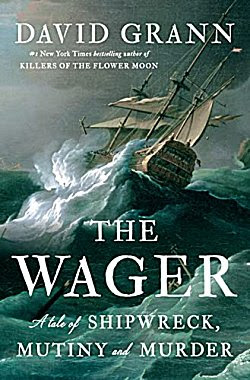
The Wager: A Tale of Shipwreck, Mutiny and Murder by David Grann

 
First Line from the Prologue: The only impartial witness was the sun.
 
In January 1742, a dilapidated boat carrying thirty men who were barely alive washed ashore on the coast of Brazil. They were survivors of the shipwrecked HMS Wager, part of a flotilla of British ships sent to war on the Spanish. The Wager had wrecked on an island in Patagonia after an unsuccessful attempt to round Cape Horn. After being marooned for months with little shelter or food, these men managed to piece together a boat and set out on a 3,000-mile journey that took over one hundred days. They were hailed as heroes.

Six months later, an even more decrepit craft landed on the coast of Chile. The three castaways aboard this boat had a very different tale to tell: those thirty men in Brazil weren't heroes, they were mutineers.

When all the survivors returned to England, accusations flew thick and fast. The alleged mutineers told of a captain not fit for duty-- a captain who shot and killed a fellow crew member with no warning whatsoever. When the Admiralty convened a court-martial, there was a lot more that had to be settled than the mere loss of a ship, and whomever the court found guilty would hang.

~

David Grann is one of my favorite authors, and his Killers of the Flower Moon is one of my all-time favorite non-fiction books. Since I have an interest in maritime history, I knew I had to read The Wager, which describes one of the longest castaway voyages ever recorded.

Grann set the stage so well that readers feel as though they're on board ship with the officers and crew. This was the time of press gangs when the British Navy had so much trouble finding enough sailors to man their ships that they'd send groups of men to roam the streets outside pubs at night to kidnap men and force them aboard ships for duty that could last years. This meant that not all the men on the Wager wanted to be there. As the voyage progressed, scurvy set in, and as men began to die, the Wager found itself with a new captain named Cheap, a man who would be called "Jobsworth" by the British (as in it was more than Cheap's job was worth to go against his orders). Cheap's bungling and indecision were instrumental in the Wager's unsuccessful attempt to round Cape Horn, ending with the ship being wrecked and the survivors being castaways on a desolate island in Patagonia. This isn't the first book I've read about the land, the seas, and the weather of the Tierra del Fuego, but Grann wrote of it so well that I felt seasick, wet, and frozen solid as I turned the pages. The months the castaways spent on that island, trying to survive and trying to escape, were brutal.

Grann immersed me in these men's lives-- one of whom would be the grandfather of the poet, Lord Byron. (Yes, Byron's experiences were important in light of one of his descendants, but the crew member who had the most impact on me was the free Black man on the Wager, John Duck.) Grann also reminded me of the integral part sailors played in the history of our clothing and our language. However, the one thing that I enjoyed the most was how he exposed what was really going on and how the Wager's original assignment and the proceedings of the court martial at the end actually fit into the much larger world stage. 

Any reader with an interest in ships, the sea, human nature, and government machinations should read The Wager.

The Wager: A Tale of Shipwreck, Mutiny and Murder by David Grann
eISBN: 9780385534277
Knopf Doubleday © 2023
eBook, 352 pages
 
Non-Fiction, Standalone
Rating: B+
Source: Net Galley

Wednesday, March 15, 2023

The World's Greatest Sea Mysteries by Michael and Mollie Hardwick

 
First Line from Introduction: The world is made up of four elements, said Aristotle: Earth, Air, Fire, and Water.
 
Who knows? Perhaps my lifelong interest in maritime history is due to the Navy men in my family, which is why I picked up Michael and Mollie Hardwick's The World's Greatest Sea Mysteries.
 
Originally published in 1967, the Hardwicks cover a wide range of maritime mysteries in twenty-eight chapters. The book's emphasis is slanted to British readers, and-- due to it being over fifty years old-- it does occasionally feel dated, but it still held my interest throughout.

The precariousness of life can be seen in letters returned to senders marked "Sailed for England" or the much more dire "SHIP FOUNDERED". Readers can learn about men who had similar experiences with whales as Jonah. There are pirates, lost treasures, and men disappearing in their attempts to find the Northwest Passage. Perhaps the most unsettling to me were the floating derelict ships, but the most mystifying was the racehorse found on an uninhabited island many miles from the mainland.

If you have an interest in the sea and its centuries-worth of mysteries, you should be able to find several items of interest in this book.

The World's Greatest Sea Mysteries by Michael and Mollie Hardwick
eISBN: 9781800555921
Sapere Books © 2022
Originally published in 1967.
eBook, 301 pages
 
Non-Fiction
Rating: B
Source: Net Galley