Showing posts with label David Grann. Show all posts

Monday, April 17, 2023

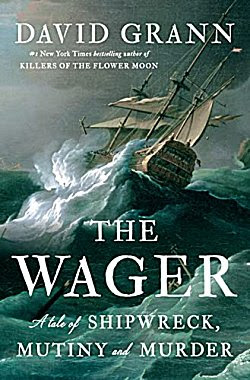
The Wager: A Tale of Shipwreck, Mutiny and Murder by David Grann

 
First Line from the Prologue: The only impartial witness was the sun.
 
In January 1742, a dilapidated boat carrying thirty men who were barely alive washed ashore on the coast of Brazil. They were survivors of the shipwrecked HMS Wager, part of a flotilla of British ships sent to war on the Spanish. The Wager had wrecked on an island in Patagonia after an unsuccessful attempt to round Cape Horn. After being marooned for months with little shelter or food, these men managed to piece together a boat and set out on a 3,000-mile journey that took over one hundred days. They were hailed as heroes.

Six months later, an even more decrepit craft landed on the coast of Chile. The three castaways aboard this boat had a very different tale to tell: those thirty men in Brazil weren't heroes, they were mutineers.

When all the survivors returned to England, accusations flew thick and fast. The alleged mutineers told of a captain not fit for duty-- a captain who shot and killed a fellow crew member with no warning whatsoever. When the Admiralty convened a court-martial, there was a lot more that had to be settled than the mere loss of a ship, and whomever the court found guilty would hang.

~

David Grann is one of my favorite authors, and his Killers of the Flower Moon is one of my all-time favorite non-fiction books. Since I have an interest in maritime history, I knew I had to read The Wager, which describes one of the longest castaway voyages ever recorded.

Grann set the stage so well that readers feel as though they're on board ship with the officers and crew. This was the time of press gangs when the British Navy had so much trouble finding enough sailors to man their ships that they'd send groups of men to roam the streets outside pubs at night to kidnap men and force them aboard ships for duty that could last years. This meant that not all the men on the Wager wanted to be there. As the voyage progressed, scurvy set in, and as men began to die, the Wager found itself with a new captain named Cheap, a man who would be called "Jobsworth" by the British (as in it was more than Cheap's job was worth to go against his orders). Cheap's bungling and indecision were instrumental in the Wager's unsuccessful attempt to round Cape Horn, ending with the ship being wrecked and the survivors being castaways on a desolate island in Patagonia. This isn't the first book I've read about the land, the seas, and the weather of the Tierra del Fuego, but Grann wrote of it so well that I felt seasick, wet, and frozen solid as I turned the pages. The months the castaways spent on that island, trying to survive and trying to escape, were brutal.

Grann immersed me in these men's lives-- one of whom would be the grandfather of the poet, Lord Byron. (Yes, Byron's experiences were important in light of one of his descendants, but the crew member who had the most impact on me was the free Black man on the Wager, John Duck.) Grann also reminded me of the integral part sailors played in the history of our clothing and our language. However, the one thing that I enjoyed the most was how he exposed what was really going on and how the Wager's original assignment and the proceedings of the court martial at the end actually fit into the much larger world stage. 

Any reader with an interest in ships, the sea, human nature, and government machinations should read The Wager.

The Wager: A Tale of Shipwreck, Mutiny and Murder by David Grann
eISBN: 9780385534277
Knopf Doubleday © 2023
eBook, 352 pages
 
Non-Fiction, Standalone
Rating: B+
Source: Net Galley

Wednesday, August 09, 2017

I Have David Grann Covered!


One week, I choose my comparison title because I need a reminder to read that author's books. Another week, the title is a suggestion from a reader. This week, it's because I want to remind all of you of one of the best books I read last year. 

David Grann's Killers of the Flower Moon haunts me still, and I now count it among my all-time favorite non-fiction books. (One of these days, I'm going to share a few of my "favorites" lists on Kittling: Books' Facebook page.) How could I resist having it as one of my US vs UK comparison titles when I happened to come across its UK incarnation? Speaking of which, let's take a look at the covers now!


Two very different interpretations, aren't they?

Both use red as the predominant color, which certainly ties in with the book's subject, but one of the first things I noticed was the difference in titles. Both use Killers of the Flower Moon, but while the US cover says The Osage Murders and the Birth of the FBI, the UK title continues with Oil, Money, Murder and the Birth of the FBI. I think this change was a wise decision on the part of the UK publisher. Not many people across the pond are going to know that there's a Native American nation called the Osage in Oklahoma, but "oil, money, murder"? That's bound to catch the eye of many inquisitive readers. (While I'm at it, I should go ahead, be honest, and say that there probably aren't all that many Americans who know about the Osage.)

For once, the US cover seems more restrained than the UK cover. It has an atmospheric graphic, with the full moon shining behind an oil derrick, and clouds that resemble buffalo thundering up a hill. The only other thing besides the title and author is a reminder that the author wrote a bestseller called The Lost City of Z

I do wish that the UK cover didn't have those two author blurbs on it, even though I do like both writers. One-word blurbs like "stunning" and "magnificent" always make me wonder about their context. I've seen words like these taken from reviews that basically said the book was a stinker. I do prefer the graphic on the UK cover. It shows a rather bleak red landscape, a landscape that's soaked with the blood of so many Osage dead. The gushing oil derrick in the distance just over the top of the hill shows the reason why so many people died.

I am really torn. I prefer the graphic on the UK cover, although I think the two blurbs spoil its appearance. Ultimately I'm going to choose the US cover. Why? Because when I first learned about this book, all I saw was the title and the author's name. There was no graphic. I had all I needed to tell me that I must read this book, and those two elements shine like a beacon on the more balanced US cover.  

What about you? Which cover do you prefer? US? UK? Too close to call? Neither one? Inquiring minds would love to know!


Tuesday, December 27, 2016

Killers of the Flower Moon: The Osage Murders and the Birth of the FBI by David Grann


First Line: In April, millions of tiny flowers spread over the blackjack hills and vast prairies in the Osage territory of Oklahoma.

After oil was discovered beneath their land in the 1920s, the richest people per capita in the world were members of the Osage Indian nation in Oklahoma. They built mansions, rode in chauffeured limousines, and sent their children to study in Europe. Then, one by one, the Osage began to be killed off, and the family of one Osage woman in particular, Mollie Burkhart, was a prime target.

This may have been one of the last remnants of the Wild West, but some people began to notice these deaths. When they tried to investigate they, too, began to die. When the death toll climbed to more than twenty-four, the FBI was called in on one of its first major homicide investigations. When the case was badly bungled, a desperate young J. Edgar Hoover put former Texas Ranger Tom White in charge. White put together an undercover team, and with plenty of hard work, they began to uncover a conspiracy that will make your blood run cold.

Author David Grann spent years doing research and uncovering new evidence in writing Killers of the Flower Moon. Since I was a fan of his from reading The Lost City of Z, I expected this latest book to be the sort of non-fiction I love: the kind that reads like the best fiction. I was not disappointed. What I did not expect was just how infuriated I would become by reading it.

Having been a huge horse racing fan when I was a teenager, I knew about the wealth of the Osage Nation in the 1920s. One of the Osage owned a winner of the Kentucky Derby. But that knowledge was just cursory. I had no idea how rich the Osage really were, and I certainly didn't have a clue that the government didn't trust them with all that money. I should not have been so naive. It had to madden many whites that, although they'd shoved the Osage onto a piece of land they deemed unfit for themselves, oil would be discovered and the Osage would turn out to be the wealthiest people in the world. The one way they had of trying to horn in on this wealth was by declaring that the Osage were not fit to use their own money wisely. In many cases whites were put in charge of the families' money, and they gave their wards allowances (and themselves large fees for their business knowledge). 

Why on earth should I be so surprised that this greed would escalate to murder? It is the natural progression after all. To this day, the Osage have trust issues, and who can blame them? They tried to get dozens of murders investigated, but instead the killings were covered up. What Grann did in Killers of the Flower Moon was to dig deeper and deeper and expose just how huge the problem actually was. As I read, words like horrifying, unspeakable, and several others flashed through my mind. 

This is an uncomfortable read for anyone with a conscience; nevertheless, it is a fascinating and important one. I highly recommend it. Although Killers of the Flower Moon won't be available until April 2017, I wanted to give you all a heads up about one of the best books I read in 2016. It's a mesmerizing true historical mystery that grabs you and won't let you go.   


Killers of the Flower Moon: The Osage Murders and the Birth of the FBI by David Grann
eISBN: 9780385534253
Doubleday © 2017
eBook, 352 pages

Non-Fiction, Standalone
Rating: A+
Source: Net Galley


Sunday, December 14, 2008

REVIEW: The Lost City of Z


Title: The Lost City of Z: A Tale of Deadly Obsession in the Amazon
Author: David Grann
ISBN: 9780385513531/ Doubleday
History
Rating: B+

First Line: On a cold January day in 1925, a tall, distinguished gentleman hurried across the docks in Hoboken, New Jersey, toward the S.S. Vauban, a five-hundred-and-eleven-foot ocean liner bound for Rio de Janeiro.


Author David Grann admits that he's not the spontaneous Indiana Jones type:

Let me be clear: I am not an explorer or an adventurer. I don't climb mountains or hunt. I don't even like to camp. I stand less than five feet nine inches tall and am nearly forty years old, with a blossoming waistline, and thinning black hair.... I have a terrible sense of direction and tend to forget where I am on the subway and miss my stop in Brooklyn.

Why on earth would someone like this decide to find out what happened to a world-renowned explorer who disappeared in the Amazon over eighty years ago? Because when he's working on a story, it's a completely different ball game. When he was young, Grann was drawn to mystery and adventure tales, and the story of Colonel Percy Harrison Fawcett, an explorer who vanished in 1925 while searching for a fabled lost civilization in the Amazon, is certainly filled with both.

In 2004, Grann was researching the mysterious death of a Conan Doyle and Sherlock Holmes expert when he came across a reference to Fawcett's role in inspiring Conan Doyle's The Lost World. As he read more about Fawcett, he became intrigued with the idea of a sophisticated civilization with monumental architecture existing in the Amazon since many experts have always believed the area could never support one. This led to more research on Fawcett. When he was given access to Fawcett's papers, Grann found clues that made him believe he could not only find out what happened to Fawcett--he could find what he had dubbed the Lost City of Z. Once he had those clues, there was no turning back.

The Lost City of Z tells us of the life and adventures of Fawcett, and how his family coped while he was off exploring. The sections taking place in the Amazon are vivid and fascinating. More than once I found myself doing a self-check for parasites and wanting to place an order for massive quantities of mosquito netting. Instead of the usual birdsong, I was hearing the howls and screeches of monkeys. If I have any quibble about this book, it's the fact that the focus is almost entirely on Fawcett; Grann doesn't spend enough time telling us about his own experiences as an explorer. The differences between Fawcett's Amazon and Grann's is often startling. I usually finish a book wondering what happened to the editor--a hundred pages could have been axed without hurting the story one bit. This is one instance where I feel like Oliver. Please Mr. Grann, may I have some more?

The Lost City of Z will be published in February. You can pre-order a copy from Amazon now. If you enjoy armchair exploration and the answer to an eighty-year-old mystery, that pre-order sounds like a good plan!

Read Alyce's review on At Home With Books.
Read Fyrefly's review on Fyrefly's Book Blog.