Showing posts with label Francine Mathews. Show all posts

Tuesday, October 25, 2022

November 2022 New Mystery Releases!

 
Here it is, the end of October, and it's finally cooling down here in the desert. As I write this, the high temperature is only going to be 84°F/29°C, and I have to admit that, if I can't spend my days in the pool, the mid-eighties is the perfect temperature range for me. (Told you I don't like the cold!) Denis and I can get out and roam outdoors to our hearts' content without the fear of being fried on the hoof, although we do still need our hats and sunscreen.
 
The past couple of months, I've been treated to some excellent books that have made my Best Reads of 2022 list, and I'm definitely hoping that this trend continues. To that end, you know I'm keeping my eyes peeled for new crime fiction to read.
 
The following books are what I consider to be the crème de la crème. I've grouped them according to their release dates, and their covers and synopses are courtesy of my favorite showroom, Amazon. Let's see if I've chosen any that tickle your fancy, too.
 
 
=== November 1 ===
 
 
Title: Death on a Winter Stroll
Series: #7 in the Merry Folger police procedural series set on Nantucket Island.
288 pages
 
Synopsis: "Nantucket Police Chief Meredith Folger is acutely conscious of the stress COVID-19 has placed on the community she loves. Although the island has proved a refuge for many during the pandemic, the cost to Nantucket has been high. Merry hopes that the Christmas Stroll, one of Nantucket’s favorite traditions, in which Main Street is transformed into a winter wonderland, will lift the island’s spirits. But the arrival of a large-scale TV production, and the Secretary of State and her family, complicates matters significantly.
 
The TV shoot is plagued with problems from within, as a shady, power-hungry producer clashes with strong-willed actors. Across Nantucket, the Secretary’s troubled stepson keeps shaking off his security detail to visit a dilapidated house near conservation land, where an intriguing recluse guards secrets of her own. With all parties overly conscious of spending too much time in the public eye and secrets swirling around both camps, it is difficult to parse what behavior is suspicious or not—until the bodies turn up.
 
Now, it’s up to Merry and Detective Howie Seitz to find a connection between two seemingly unconnected murders and catch the killer. But when everyone has a motive, and half of the suspects are politicians and actors, how can Merry and Howie tell fact from fiction?
 
This latest installment in critically acclaimed author Francine Mathews’s Merry Folger series is an immersive escape to festive Nantucket, a poignant exploration of grief as a result of parental absence, and a delicious new mystery to keep you guessing.
"
 
 
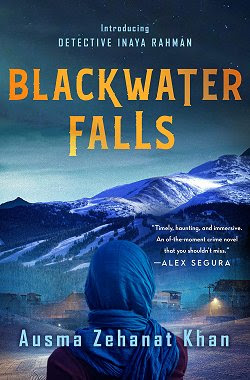
Title: Blackwater Falls
Series: #1 in the Detective Inaya Rahman police procedural series set in Colorado.
384 pages
 
*Upcoming review on Kittling: Books.
 
Synopsis: "Girls from immigrant communities have been disappearing for months in the Colorado town of Blackwater Falls, but the local sheriff is slow to act and the fates of the missing girls largely ignored. At last, the calls for justice become too loud to ignore when the body of a star student and refugee--the Syrian teenager Razan Elkader--is positioned deliberately in a mosque.

Detective Inaya Rahman and Lieutenant Waqas Seif of the Denver Police are recruited to solve Razan’s murder, and quickly uncover a link to other missing and murdered girls. But as Inaya gets closer to the truth, Seif finds ways to obstruct the investigation. Inaya may be drawn to him, but she is wary of his motives: he may be covering up the crimes of their boss, whose connections in Blackwater run deep.

Inaya turns to her female colleagues, attorney Areesha Adams and Detective Catalina Hernandez, for help in finding the truth. The three have bonded through their experiences as members of vulnerable groups and now they must work together to expose the conspiracy behind the murders before another girl disappears.

Delving deep into racial tensions, and police corruption and violence,
Blackwater Falls examines a series of crimes within the context of contemporary American politics with compassion and searing insight.


Title: It Came Upon a Midnight Shear
Author: Allie Pleiter
Series: #3 in the Riverbank Knitting cozy series set in Maryland.
304 pages
 
Synopsis: "The holiday season looks merry and bright for Libby and her friends at Y.A.R.N. The store is expanding for a holiday boom, and she’s gathered Collinstown’s businesses to decorate a community Christmas tree. Dashing “Gallant Herdsman” Vincenzo Marani arrives to showcase the rare vicuña, whose coat produces the world’s most luxurious yarn. It’s a perfect yuletide—until Libby’s ex-husband, Sterling, turns up in town…and then turns up dead.

The murder unravels Libby’s life faster than a hand-knit Christmas stocking. The luxe yarn goes missing, Sterling’s domineering family comes to town, and the vicuña attempt an escape. If Libby can’t stitch up a solution to the case, she may be trading in her knitting needles for a set of handcuffs.
 
 
=== November 8 ===
 
 
Title: Outback
Author: Patricia Wolf
Series: #1 in the DS Lucas Walker police procedural series set in Australia.
320 pages
 
*Upcoming review on Kittling: Books.
 
Synopsis: "DS Lucas Walker is on leave in his hometown of Caloodie, taking care of his dying grandmother. When two young German backpackers, Berndt and Rita, vanish from the area, he finds himself unofficially on the case. But why all the interest from the Federal Police when they have probably just ditched the heat and dust of the outback for the coast?

As the number of days since the couple's disappearance climbs, DS Walker is joined by Rita's older sister. A detective herself with Berlin CID, she has flown to Australia - desperate to find her sister before it's too late.

Working in the organised crime unit has opened Walker's eyes to the growing drug trade in Australia's remote interior, and he remains convinced there is more at play.

As temperatures soar, the search for Berndt and Rita becomes ever more urgent. Even if Walker does find the young couple, will it be too late?


Title: Desert Star
Series: #5 in the Renée Ballard police procedural series set in California. (Also features Harry Bosch.)
400 pages
 
Synopsis: "A year has passed since LAPD detective Renée Ballard quit the force in the face of misogyny, demoralization, and endless red tape. But after the chief of police himself tells her she can write her own ticket within the department, Ballard takes back her badge, leaving “the Late Show” to rebuild and lead the cold case unit at the elite Robbery-Homicide Division.

For years, Harry Bosch has been working a case that haunts him—the murder of an entire family by a psychopath who still walks free. Ballard makes Bosch an offer: come volunteer as an investigator in her new Open-Unsolved Unit, and he can pursue his “white whale” with the resources of the LAPD behind him.

First priority for Ballard is to clear the unsolved rape and murder of a sixteen-year-old girl. The decades-old case is essential to the councilman who supported re-forming the unit, and who could shutter it again—the victim was his sister. When Ballard gets a “cold hit” connecting the killing to a similar crime, proving that a serial predator has been at work in the city for years, the political pressure has never been higher. To keep momentum going, she has to pull Bosch off his own investigation, the case that is the consummation of his lifelong mission.

The two must put aside old resentments and new tensions to run to ground not one but two dangerous killers who have operated with brash impunity.
 
 
Title: Peril in Paris
Author: Rhys Bowen
Series: #16 in the Royal Spyness historical mystery series set in 1930s France.
304 pages
 
Synopsis: "What a delight it is to finally be able to enjoy a simple meal again! I have been in the throes of morning sickness for the last few months as Darcy and I prepare to welcome a brand-new addition to our little family. Now that I am feeling better, I have realized I am dreadfully bored! It seems that all my nearest and dearest are off leading their own busy lives while I sit at home and attempt to train our two adorably naughty puppies. Fun as it may be, it is hard not to long for a little adventure, a change of pace, before my true confinement begins when the baby comes.

Happily, it seems that Darcy has read my mind. When I receive a letter from my glamorous best friend, Belinda, Darcy suggests we take a trip to Paris to visit her. It seems he also has a spot of business of which to take care, so I will be staying in Belinda’s flat as she works feverishly on Coco Chanel’s fall collection. I happen to know Coco from a disastrous encounter in Nice years ago, and I am hoping this visit will go much more smoothly. But I soon learn that nothing about my time in Paris is going to be simple . . . or safe for that matter.

Darcy has asked me to take on a small chore as a part of his latest assignment. I am to covertly retrieve something from an attendee of Coco’s show. It seems easy enough, but I discover that this little errand could have terrifying consequences for a world on the brink of war. When things go horribly wrong, I am left to find a killer all while trying to fend off a French policeman who is certain that I am a criminal mastermind. But I have no plans to deliver my darling little one in a prison cell, and so I will muster every ounce of my courage to save the day . . . and, quite possibly, the world!


=== November 10 ===


Title: A Killer Christmas at Honeychurch Hall
Series: #9 in the Kat Stanford/Honeychurch Hall cozy series set in England.
288 pages

Synopsis: "Following the butler's death and the cook's retirement, the ever-gullible Lady Lavinia replaces them with a power couple who are determined to thrust the crumbling estate into the 21st century. The Dowager Countess reluctantly agrees to hold a big-ticket Christmas gala and silent auction with a mystery celebrity flying in from Monaco as the guest of honour.

Needless to say the newcomers' make a few enemies in their quest to change the status quo and when one body is discovered in the Victorian stumpery and a second, in the ha-ha, it seems that their high-flying past is catching up with them.

Meanwhile, Kat is dealing with the theft of a valuable doll that had been earmarked for the auction. When it turns out that all the ticket money has vanished and there never was a celebrity guest, it's up to Kat to save the day and bring the cold-blooded killer to justice.
"


=== November 15 ===


Title: Dark of Night
Author: Barbara Nickless
Series: #2 in the Dr. Evan Wilding police procedural series set in Illinois.
367 pages
 
Synopsis: "What an exotic way to die in Chicago.

When esteemed historian Elizabeth Lawrence is found in her car, killed by a cobra’s bite, only a brilliant professor of semiotics, Dr. Evan Wilding, can see the signs around her strange death. As he helps homicide detective Addie Bisset decipher the scene, the puzzles left behind offer Evan chilling passage into the mind of a killer.

Evan’s investigation merges with that of an Israeli agent, who claims Elizabeth was close to acquiring an invaluable artifact. She was also drawing the attention of unsavory treasure hunters, forgers, and thieves. Was someone desperate to expose the truth of Elizabeth’s astonishing discovery?

The deeper Evan and Addie delve into the case, the darker it gets. A murderer’s archaic crimes are just the beginning. In a race where there can be only one winner, the final victim might be Evan.
 
 
Title: A Ghost of Caribou
Series: #3 in the Alex Carter wildlife biologist series set in Washington state.
320 pages
 
Synopsis: "When a remote camera on a large, rugged expanse held by the Land Trust for Wildlife Conservation picks up a blurry image of what could be a mountain caribou, they contact Alex Carter to investigate. After all, mountain caribou went extinct in the contiguous U.S. years ago, and if one has wandered down from Canada, it’s monumental.

But when Alex arrives on scene in the Selkirk mountains of northeastern Washington state, she quickly learns that her only challenge isn’t finding an elusive caribou on a massive piece of land. The nearby townspeople are agitated; loggers and activists clash over a swath of old growth forest marked for clearcutting. The murdered body of a forest ranger is found strung up in the town’s park, and Alex learns of a backcountry hiker who went missing in the same area the year before.

As she ventures into the forest in search of the endangered animal, she quickly finds herself in a fight for her life, caught between factions warring for the future of the forest and a murderer stalking the dense groves of ancient trees.
 
 
Title: Bleeding Heart Yard
Series: #3 in the Harbinder Kaur police procedural series set in England.
352 pages
 
Synopsis: "When Cassie Fitzgerald was at school in the late 90s, she and her friends killed a fellow student. Almost twenty years later, Cassie is a happily married mother who loves her job—as a police officer. She closely guards the secret she has all but erased from her memory.

One day her husband finally persuades her to go to a school reunion. Cassie catches up with her high-achieving old friends from the Manor Park School—among them two politicians, a rock star, and a famous actress. But then, shockingly, one of them, Garfield Rice, is found dead in the school bathroom, supposedly from a drug overdose. As Garfield was an eminent—and controversial—MP and the investigation is high profile, it’s headed by Cassie’s new boss, DI Harbinder Kaur, freshly promoted and newly arrived in London. The trouble is, Cassie can’t shake the feeling that one of them has killed again.

Is Cassie right, or was Garfield murdered by one of his political cronies? It’s in Cassie’s interest to skew the investigation so that it looks like it has nothing to do with Manor Park and she seems to be succeeding.

Until someone else from the reunion is found dead in Bleeding Heart Yard…
 
 
Title: The Twist of a Knife
Series: #4 in the Hawthorne & Horowitz series set in England.
384 pages
 
Synopsis: "“I’m sorry but the answer’s no.” Reluctant author, Anthony Horowitz, has had enough. He tells ex-detective Daniel Hawthorne that after three books he’s splitting and their deal is over.

The truth is that Anthony has other things on his mind.

His new play, a thriller called Mindgame, is about to open at the Vaudeville Theater in London’s West End. Not surprisingly, Hawthorne declines a ticket to the opening night.

The play is panned by the critics. In particular, Sunday Times critic Margaret Throsby gives it a savage review, focusing particularly on the writing. The next day, Throsby is stabbed in the heart with an ornamental dagger which turns out to belong to Anthony, and has his fingerprints all over it.

Anthony is arrested by an old enemy . . . Detective Inspector Cara Grunshaw. She still carries a grudge from her failure to solve the case described in the second Hawthorne adventure, The Sentence is Death, and blames Anthony. Now she’s out for revenge.

Thrown into prison and fearing for both his personal future and his writing career, Anthony is the prime suspect in Throsby’s murder and when a second theatre critic is found to have died in mysterious circumstances, the net closes in. Ever more desperate, he realizes that only one man can help him.

But will Hawthorne take the call?
 
 
=== November 29 ===
 
 
Title: An Act of Foul Play
Author: T.E. Kinsey
Series: #9 in the Lady Hardcastle historical mystery series set in turn-of-the-20th-century England.
303 pages
 
*Upcoming review on Kittling: Books.
 
Synopsis: "November 1911. Lady Emily Hardcastle is celebrating her birthday by seeing a play at the Duke’s Theatre in Bristol with her maid and confidante, the inimitable Flo. Act One is a triumph. Then Act Two opens with a body on stage―a real one. One of the cast has been brutally murdered during the interval.

When other matters get in the way of Inspector Sunderland overseeing the case himself, he asks the ever-resourceful Lady H to keep a watchful eye on the suspects―and his police colleagues. Rustling up some cunning disguises of their own, she and Flo are soon in deep cover among the cast and crew, pulling back the curtain on some shocking secrets and rivalries…

The problem is, everyone seems to have a motive, and everyone seems to have an alibi…In this locked-room mystery in which nothing is as it seems, the amateur sleuths need to put on the performances of their lives if they’re to stand a chance of shining a spotlight on the truth…


November is another month in which several of my favorite authors have new books being released. I think the publishers are hoping that we all blow our budgets on book buying, don't you?
 
Which new books tickle your fancy most? Inquiring minds would love to know!

Monday, April 27, 2020

Death on Tuckernuck by Francine Mathews


First Line: He hadn't expected Ash that Saturday morning, hurrying down the weathered wooden pier in her rope soled wedges and skinny jeans, a slouchy silk sweater slipping down to reveal one perfect shoulder.

A Category 3 hurricane is bearing down on Nantucket Island. As caretakers of Tuckernuck, a private exclusive island off the western tip of Nantucket, Dionis Mather and her father Jerry have to make sure everything is battened down, but when Dionis gets word that a star NFL player's horses are unsecured, she's certain she can get them in their barn and still have plenty of time to get back to Nantucket before the hurricane hits.

Detective Merry Folger has more on her mind than a hurricane-- just a little something called her wedding-- and that jerk of a police chief is making her work practically right up until time for the ceremony. When the Coast Guard alerts Nantucket police of a luxury yacht grounded on the shoals off Tuckernuck's northern edge-- with two shooting victims in the main cabin-- Merry rushes to get to the crime scene before all the evidence is washed away. As she puts all the pieces together, she realizes that she might have to risk everything in order to bring a criminal to justice.

If you want to read books that make you feel as though you're experiencing life on Nantucket Island, you need to read Francine Mathew's Merry Folger series. It also goes without saying that, if you want to "experience" a hurricane without actually living through one, you need to read Death on Tuckernuck.

The mystery is a cracker. Readers have a little inside knowledge that characters like Dionis and Merry don't-- how many people were on board that yacht for instance-- but that's certainly not enough to put all the pieces together until Merry's hard work begins to pay off. (And that hard work of hers will pay off in unexpected ways.) The only real question is: Is the wedding still on despite a murder investigation and a hurricane?

That you will have to find out for yourself, and you are going to enjoy yourself while doing so. New to the series? I'll be honest with you. I've read only three books in this series, the first and the most recent two, and I haven't felt lost. But the setting is superb and the characters and stories so strong that you might just want to start with the first, Death in the Off-Season and enjoy the sea breeze along with a murder or two.


Death on Tuckernuck by Francine Mathews
eISBN: 9781616959944
Soho Press © 2020
eBook, 264 pages

Police Procedural, #6 Merry Folger mystery
Rating: A
Source: Net Galley


Wednesday, July 17, 2019

Juliet Grames at The Poisoned Pen!


When I heard that Stephanie Barron (AKA Francine Mathews) would be interviewing author/editor Juliet Grames at The Poisoned Pen, I knew Denis and I would have to go. I've seen both women before at Poisoned Pen Conferences and Left Coast Crime when it was here in Phoenix, so I knew we were in for a treat. I just didn't know how delicious the treat would be! I'd always known Juliet in her role as editor for Soho Press, so seeing her as a writer being interviewed by one of her authors was a must-see.

I'm going to skip the chatter and head straight for the interview. I record them now which means not only can I share more of the interview verbatim with you, but also I can enjoy myself more during the event because I'm not scribbling furiously every second. Let's get started!


Don't you just love it when someone tall comes in at the last second and sits in front of you? Stephanie Barron (left) and Juliet Grames (right)


Barbara Peters: Good evening, everyone. Thank you for coming out. I always encourage you to come and meet debut authors because then you will have bragging rights forever, right, in case they turn into a bestseller or a critical hit. The hilarious part of this is that the three of us have known each other for years. She's an editor at Soho which is part of Penguin Random House. Francine, AKA Stephanie Barron, has published many books with Random House, and now I am an editor at Random House. It's just really amazing how it's all worked out.

Anyhow, that's not the point of the evening. Francine and Juliet are here to discuss Juliet's book and also turn the tables and find out what it's like for an author to grill an editor. I'm going to pass around cookies, sit down over here and enjoy it!

Stephanie Barron aka Francine Mathews
Stephanie: I'm so glad all of you joined us tonight because Juliet is one of my favorite people in the world. She is, as Barbara said, my editor. She has edited my Jane Austen mysteries as well as supervised the revision of my entire Nantucket series.

Juliet and I have worked a lot together. One of the reasons I was so thrilled to find her and have her agree to take me on as a writer is because she actually edits. Those of you who know book publishing won't be surprised to learn that many of the people in New York in publishing are focused on acquiring books but not necessarily on actually editing them. I'm glad that she's getting the hot property treatment and I'm looking forward to having her talk about it. Juliet was the hot property with Stella Fortuna about a year ago and had a dizzying experience with the sale of her first manuscript.

Juliet: It's still pretty dizzy! [audience laughter]

Stephanie: What I love about Juliet's editing is that she's extremely thoughtful and very well versed in the canon of English literature. She's deeply interested in character development... and all these things I've experienced as a writer being edited by Juliet are amply in evidence in her first novel, The Seven or Eight Deaths of Stella Fortuna. Fascinatingly, when I first started working with Juliet, I didn't know that she was a writer as well. It's unusual, obviously, to wear both hats because they're both so time-consuming. Juliet is also an associate publisher at Soho which means that she's responsible for so much of the running of the company.

She mentioned at one point-- I think we were at a bar-- that she was finishing her novel, and I was blown away. Then I learned that the woman who is now my editor at Random House-- because I have editors at both houses-- in fact tried to buy Juliet's book. So it's that sort of six degrees of separation. So, Juliet, if you could, I know you've done this quite a bit because I've seen you on video doing this... if you could explain a bit about your inspiration for Stella Fortuna and how you were compelled to write the book we have sitting here in front of us today.

Juliet Grames
Juliet: Sure, and thank you for your very generous introduction. I hope I deserve all that!

The Seven or Eight Deaths of Stella Fortuna is a novel about two sisters. When we meet them, they're about one hundred years old, and they've been locked in a blood feud for about thirty years. The book purports to go back to the beginning of their lives in a tiny village in southern Italy and unpack what made them go from being best friends to bitter enemies. It tells the hundred-year life story of these sisters, their feud, and specifically the main character of Stella who has really bad luck and lots of near-death experiences.

I come from a very tight-knit Italian-American family. You can see that my parents and baby are here. They traveled from two states on the East Coast in order to be here, so we're just a very tribal people. A lot of Italian families are very tight-knit. My grandmother was, in fact, an immigrant. She came over in the 1930s when she was a teenager. The core relationship between the two sisters was inspired by her and her sister. They were very involved in my childhood. They took care of me when my parents were working before I went to kindergarten. They were a huge part of my life.

When I was five years old, my grandmother had a brain injury that ended in a life-saving lobotomy. She lived an additional thirty years after the lobotomy, but it completely changed her personality and caused this terrible feud with her sister that no one ever understood. I used that heartbreaking family schism as a jumping-off point to unpack the Italian-American immigrant story. I was really fascinated by the region of southern Italy that they came from-- Calabria, which I found very difficult to read about because there's not a ton written about it, so I really wanted to put down something in text for other people to know more. And also to collect some of the lore from other immigrant families who'd come over to live in the Hartford area where my family settled. Those were my two aims. One, to try to represent the Calabrian experience, and two, to honor my grandmother and the lost person she was before this accident that completely changed her personality.

Stephanie Barron
Stephanie: That leads me to a question that kind of haunted me as I read the book, and that is how closely your fictional account is to the actual events in Stella's life, which I know wasn't your grandmother's name, but for the sake of simplicity let's call her Stella.

Juliet: The biggest problem for me in writing this book... I've told many writers whom I've worked with as an editor that when you hit a wall with your story, follow the character. The character will get you through. You should write from character to plot and not the other way around.

In this case, trying to follow the beats of my grandmother's life story and make things hit like the facts actually happened was so hard because I didn't understand the character. My grandmother was a cipher to me. She had had part of her frontal lobe removed, so I had to decide what bits of her actual life I could use and actually understand why they happened. In the end, that ended up being the eight near-death experiences. So those are all fact. My grandmother had eight near-death experiences. Everything in between those deaths is fiction, and especially the character of Stella is fictitious because I don't know who my grandmother was as a young woman. The facts are lost or eroded by the thirty years that followed the accident. She was a person who needed to be cared for-- a burden-- although we loved her and took care of her... my family did an amazing job keeping her alive and taking care of her during that time. Still... you forget, so the deaths are real and the rest is completely invented.

Stephanie: Okay, so that leads me to a question because, having written myself about people who actually lived-- which I do a great deal-- in my work, there's always a moment where you have to step across a line in the sand, which is what you know about the character and what you decide to own and create about the character. Make that actual person your functioning guide through a story. For me, I've always had to identify a moment of vulnerability in that person. Usually, it's a moment in childhood that scars them or defines them and slightly bends the nature of their personality as they move forward through life. That gives me a handle on them.

Juliet Grames
Juliet: That sounds very realistic to me!

Stephanie: Well, I'm interested because you know about the eight near-deaths and yet you say that you know very little about who she was. Yet the character of Stella in the book is such a strong woman, and she's strong against the backdrop of everyone around her. She is a distinctly defined personality whereas her mother, her sisters, her brothers, her father seem to fall into more generalized patterns. Not that they aren't distinct characters. The sister who's so close to her is a very biddable girl. She doesn't strike out on her own, she's a follower... but Stella is such a distinct persona that I felt like this was your grandmother. I'm interested in the choices you made and how you made them to create that person out of what you've suggested was a void.

Juliet: Part of it was imagining, but I have to be honest with you. I've never felt like a very creative person. I don't think I'm good at coming up with things from scratch. At heart, I'm sort of the history major type, and when I was really at a loss for a thing would have happened in the plot, my solace was usually research. The more I read about topics, the more I would find the arcane points, especially the women's lives that don't always make history books that would have vastly affected a day-to-day scenario.

When I was probably in fourth grade, my grandmother came to school to talk to my class about her immigration process. We were talking about where we had come from. She gets up in front of the class. My mother had come with us in case she needed to translate if my grandmother became confused and spoke the wrong language. So in front of the class, my grandmother starts talking about worms. My teacher redirected her because it was incoherent. So we talked about what it was like to go to Napoli to catch the boat, the Statue of Liberty, and New York Harbor. When we got home, my mom said, "Ma, why were you talking about worms?" My grandmother said, "You wanted to ask me about what my life was like in Italy, so it was about these silkworms." and we're all like, "What?!? Silkworms are from China. Everyone knows that!" Then my mother went to ask my great-aunt who said, "Oh yeah. When we were little, it was our only source of income. We raised silkworms all summer long." This is a totally lost art because, after World War II, it all went to the factories in the north.

Available Now!
In these remote villages-- in Calabria especially-- peddlers would come to these mountain villages, they would sell these pouches of eggs which the women would tie under their dresses against their bosom. When the eggs hatched, they would spend twenty-four hours a day for the life cycle of the worm feeding them mulberry leaves-- which needed to be harvested. It's a very demanding process that takes up a month of the year. This is how they saved up money to buy their trousseaux which were the only things they ever had in their lives. They're not allowed to own land; only the men could own land. Women are not citizens so they can't have bank accounts or income. They can only work for in-kind payment like a bottle of olive oil.

But suddenly when you understand that probably all the women in this village during the month of July are operating in a kind of fever trance of sleeplessness because they're trying to make their income for the year, it makes it much more likely that you're to have a near-fatal accident when you're not watching your child and they get into something like boiling oil. This is just one kind of extreme example, but more I learned about life and these little tiny details, the more the plot organically clicked into place. There's usually a historical explanation for why something weird happened, you just have to keep digging.

Stephanie: I completely agree with you. I think it has always been the research that has both compelled me to write a story... usually I'm interested in something and I start reading about it and peeling back the layers of the onion, and then I come to the story that is calling me to write it. That's the great gift of loving history, I think.

Juliet: This is why we like each other. [audience laughter amid the mutual agreement]

Stephanie: The arc of the story is fundamentally that Stella's childhood in Italy is radically changed by immigrating to New York and then Hartford, Connecticut, and her immersion in a new culture. You've woven that against a backdrop of a somewhat tortured romance. I was curious about your choices with that.

Juliet Grames
Juliet: That romance was an invention. But that was one of those things that came out of asking myself why. I knew I had to get her from Point A to Point B, and the more I dug into her character, the more I understood about her attitudes toward romance and marriage and sex. I would love to say more, but I don't want to spoil anything, so let me self-censor here a little bit.

I think that if you're growing up in the world Stella is, which is the 1920s, in extreme Catholic patriarchy... it's not the modern Catholic Church. The southern Italian Catholic Church, in particular, was deeply affected by four hundred years of  Spanish colonialism which was extremely exploitative. The Church is not just the church we think of, it's also the fact that it owns 80% of the land. So most people are essentially feudal slaves working for the Church, albeit through a middle man who collects a fee. Things like sex and social mores become so binding and grinding. There is no freedom anywhere you go. You don't have the power to work for yourself. I think you get a system where men are... yes, they are empowered over women-- they own their wives and their children, the wives have no personhood-- but the men own nothing else. They toil for sixteen hours a day in these miserable conditions, and often at the end of the year there's not enough money left over to pay for medicine for their children. There's just misery on every side because of this exploitative system developed under the Spanish rule.

If you're a very very good man, maybe you survive that by being a good husband and father, but if you have any personality damage done by four years of terrifying war experience or any other number of hardships that befell this generation, you may go home and take out your anger on your wife. What you may see here are a lot of demented family structures. The men are exploited by this system and then they turn around themselves and exploit. I think if you're a woman who has absolutely no power in this situation other than over her own sexuality, that's the one thing you get to hold onto. Stella sees her one path to freedom as not ever having to subject herself to a man.

Stephanie Barron
Stephanie: I found this fascinating because you chose, in writing this book, to insert yourself as a narrator so the book feels very much as though it bridges both fact and fiction. You allow readers to feel as though you are the granddaughter in the story-- and you are to a certain degree-- but also that you are our guide to this world which you created.

Juliet: I did a ton of book research. I wrote the second half of the book first because I felt that I knew it well enough. Meanwhile, I was reading everything I could on Calabria and the south in general. In English and Italian-- which I had to learn for this project. There's just so little written history. Because of the Spanish colonialism, Calabria was basically an illiterate region until the 1920s. Until recently no one was writing their own stories. Now they are, but it's about the Mob, which is a shame because there are a lot of other stories.

I got what I could out of books but ultimately the real research was in going back to my grandmother's village. I took a leave of absence from work and I lived there in the house she grew up in which is now owned by a second cousin who is a retired postman. It was really neat! The first time I met him, I was on an exploratory vacation trip, and he said, "Oh, this is your house, too. You must come and live here for a minimum of one month!" [audience laughter] He meant it, and it was great. He found out relatively early in my stay that I loved the proverbs he shared which are a huge part of Calabria's culture. It's their way of making everything funny.

He'd be taking me around. We'd be meeting people and collecting their histories. I had my tape recorder and I'd have interviews with old people, but the first thing before we sat down, he would say to them, "Tell us your favorite proverbs" and I would write them down in my notebook. By the end of my stay, I had 130 of them. I only got to use twelve in the book, but I'm saving those others! [audience laughter]

Barbara Peters. Juliet's mother is behind her.
Stephanie: Can you share some of them with us?

[Juliet would first say the proverb in Italian then repeat it in English. Want to see and hear this? Check out the event on The Poisoned Pen's Youtube channel!)

Juliet: "The old wolf loses its fur but not its wiles," which I think is great. Another one which is funny or not funny depending on how you're interpreting it is "Which do you want, the full bottle of wine or the drunk wife?"

Stephanie: Oh man, what a choice!

Juliet: These are important cultural, sociological research things that I got a lot of Calabria's character from. It was hard to actually work them in. Something else that I gathered during my time there doing research was folk songs. I learned so much folk music while I was there.

Stephanie: Which is a theme in the book.

Juliet: It is a theme in the book, but it's so hard to work everything in. There's only one song that's actually in the text which is kind of like Calabria's national anthem as I call it--"My Beautiful Calabrese Girl." It so matched the theme of the book, and the tune got stuck in my head, so it sort of wrote itself into the story. Can I sing a little of it?

Stephanie: Oh, please! [audience agreement]

Juliet sang the song in Italian, and after a verse or two, her mother, who was sitting in the audience, joined in. It was so beautiful that tears came to my eyes, and I've since learned that I wasn't the only one who had an emotional response to the song. Please... watch (and listen) to it! The song begins around the 24-minute mark.

Juliet Grames
[audience applause]

Stephanie: I have to commend you because part of the time I was reading The Seven or Eight Deaths of Stella Fortuna, I was actually listening to it on Audible, and of course, the narrator does not know how to sing that song. It's interesting to hear the differences between Italian and Calabrese.

Juliet: They are very different. Calabrese is called a dialect, but I think that's disrespectful. Just because it's not a written language, it is a language. It's full of classical and Byzantine Greek, there is a ton of Arabic. There is a ton of Albanian, and of course, Spanish.

Stephanie: I want to get back to your choice to insert yourself as a narrator, why you felt it was important to frame the book with your voice.

Juliet: Because Stephanie, we can't all do what you do! I have the very highest respect for actual historical fiction writers because what you have to do is pick your period and your theme and then stick with it and actually tell the story staying within the rules of that time period. I just couldn't do it because there were so many things I wanted to say that would not have been native to Stella's point of view. I did try to write this in first person from Stella's point of view, but I realized that I was leaving so much in the margins of the text that was making me angry to leave out. So a very modern fictional narrator began to interpolate, and I just let her stay.

Stephanie: Did you ever consider framing the book differently?

Juliet: No! [audience laughter] You mentioned that you didn't know I was writing when we first met, and at first I was really gunshy about confessing to anyone in my publishing life or wider life that I was writing because if it didn't go well, I thought it would be not only embarrassing for me but maybe reflect poorly on my career as an editor.

Juliet Grames
During the tortured years of writing this book-- because I think all the years of writing any book are torture [audience laughter]-- but in this particular situation, I had some beta readers and even an early agent read... I sent it to the person I thought would really like it and then she didn't like it, so I didn't show it to anyone else for about two years.

Stephanie: So what you were hearing was publishing's conventional wisdom...

Juliet: Yep!

Stephanie: ...about how you structure a story...

Juliet: Yep!

Stephanie: ...and yet you as an editor... bought that, and that's interesting.

Juliet: I think now, in retrospect-- and I should have known better, I've been in publishing for fifteen years-- but I think a lot of agents are looking for things... agents only make 15% of the sale-- so often they are looking for books that remind them of ones that have done well. So if you're doing something very different, it becomes harder to see how you're going to position it. On the flip side, I think editors are bored by seeing the same things over and over again, so I think they wanted the thing that didn't remind them of what they'd already seen before. My advice to aspiring authors is don't give up. The agents were the most difficult part of my publication process, but I think that's the case for many people.

I also think that if you know what your book is you should trust yourself. If it turns out that your book is only for five people, that's fine. [audience laughter]

Stephanie: Wow. That goes against everything any writer is told on a daily basis.

Juliet: Now I'm going to wear my editor hat. When I edit authors, I hope I never tell them that they're telling the wrong story or that they're telling it in the wrong way. And if that does happen, it makes me wonder if maybe we shouldn't be working together because we don't have a similar vision for the book.

Juliet Grames
I don't have the arrogance to think that what I like to read is what everyone likes to read. I think this is why we're surrounded by so many different genres right now. There are readers who are looking for different things. I think if you're a writer, you have to stick to your guns about what you want to say. I knew what I wanted to say.

Stephanie: How did you, as an editor who probably has to submit to market considerations, how you were willing to buck market considerations to a certain degree in writing your own book?

Juliet: I'm never willing to submit to market considerations which is maybe why I work at an independent press. [audience laughter] I know. I can't. As a reader, I don't want to read things that remind me of other things. I think everyone should be free to follow their hearts. [audience applause]

Stephanie: The counterpoint to this is that most large publishing houses are governed, not by editing, but by their marketing departments, and the marketing departments are focused on whether you have a platform on social networks that you can use to sell your books. They are obsessed with that. Your reach, your followers... it's all done by the writers now. It's highly unusual-- and you usually find this only in smaller publishing houses-- the willingness to allow writers to follow their hearts.

One last question: what are you thinking of focusing on next besides your beautiful baby, Carlos?

Juliet: In my research for this book, I found that villages are so remote and disconnected in Calabria during this period that you could find all this interesting information about another Calabrese village that has absolutely nothing to do with the world you're writing about, which was a great disappointment-- because I found some amazing content-- but I also found inspiration for another book! So that's where I'm at.

As you may know, I'm a crime fiction editor at Soho and that's what brings me here today via that connection. I'd like to write a crime novel after carefully studying the form for ten years, so we'll see if I can pull it off! [audience laughter] It's really hard to plot responsibly! I'm writing a book set in the 1960s in the very deep south of Calabria in a mountain range that's home to the Calabrese mob. They are one of the largest and most heinous crime syndicates in the world, and they've really flown under the radar.

I will tell you that I did drag my very good sport mother on a two and a half week exploratory tour of these Mafia villages in Calabria during the summer of 2017.


After a short Q&A session, the event was over. What a fun and informative evening-- just as I knew it would be. I wish all of you could go with me to The Poisoned Pen-- it's a little slice of heaven for book lovers!


Wednesday, February 20, 2019

At The Poisoned Pen with Stephanie Barron!


I've been fascinated with Jennie Churchill since my mother brought home Ralph G. Martin's two-volume biography of her. There was just something about that face on the cover. When I learned that one of my favorite authors, Stephanie Barron (AKA Francine Mathews) was writing a book about her, I was thrilled.

Reprint of Martin's classic
For the most part, Jennie Churchill has been given short shrift because she was a woman who lived her life the way she wanted to live it-- and the men who wrote about her did not like that. It was more than time she received a woman's touch, especially a woman as talented as Barron.

As usual, Denis and I showed up early to Barron's event at The Poisoned Pen, and although I did get some reading done, it wasn't much because Stephanie came into the bookstore early and sat down to chat with me for a few minutes. By the way, I'm calling her Stephanie throughout this post because that's the name her book is written under, but I'm used to thinking and speaking of her as Francine. (Her name is Francine Stephanie Barron Mathews.)

One of the things we talked about was the cover of That Churchill Woman. It is a striking one that shows a woman wearing elbow-length gloves and a fitted long gown in pale blue-- and we only see the woman from the bottom lip down, something I usually hate. I mentioned that to Stephanie who said that leaving off Jennie's face was a conscious decision because her face is so strong that Stephanie and the publishers thought some buyers might be put off by it. I can see their point, and I do (reluctantly) agree with it. Stephanie also showed me the four different color choices for the gown on the cover, ranging from pale cream through two shades of pink to blue. Yes indeed, blue was the best.

Of course, once we began chatting the time flew and before I knew it, the room was packed and the event was starting.

L to R: Stephanie Barron, Barbara Peters
Barbara: This is one of my dearest friends and favorite authors. She's a diverse writer-- mysteries, spy stories, women's fiction, Jane Austen... all kinds of wonderful things-- and she's brought us her new book today which is about Jennie Churchill.

Stephanie: After twenty-six years of writing, some people know me by both Stephanie Barron and Francine Mathews but most only follow one or the other. I hate to cause confusion.

Barbara: That's no fun. I love sowing confusion. [audience laughter]

Stephanie: In general, my Mathews books have a grittier edge to them than the Barron books, and in this case, there's real divergence because this is not a suspense-driven plot; it's what's known as biographic fiction.

The day before yesterday (January 24) was the anniversary of Winston Churchill's death. It was also the anniversary of his father's death seventy years before. I find it ironic because Winston had a strained relationship with his father and tried to address it by writing his father's biography. Bending over backward as a son because his father actually treated him dreadfully. I started researching Winston as a writer of spy novels-- Jack 1939 and Too Bad to Die-- in which Winston appeared as a minor character. And in researching him, I was deeply struck that most historians-- male and most of them British-- were incredibly dismissive of his mother. They describe her as irresponsible, self-indulgent, selfish, a profligate with money, a bad mother, possibly nymphomaniacal... and did I mention that she was a bad mother? [audience laughter] And oh, of course... she was American.

Available Now!
What you realize when you read Winston Churchill's male British biographers is that they to a man are outraged that the great man, the savior of Western civilization, was only half English. It just kills them. [audience laughter] They really wish he would have come from out of the sea on the half shell like Venus, fully formed-- and parentless. But they're left with the choice of lauding him for the qualities his father gave him or lauding him for the qualities his mother gave him and liking neither parent very much.

On the other hand, Winston absolutely adored Jennie. This comes through in all his autobiographical writings. "She shone for me like the evening star. I loved her dearly. From a distance." Later he says, "She became my ardent supporter with all her wit and energy, and the two of us were more like brother and sister than child and parent, or so it seemed to me. And so it went on till the end."

So I was confounded by the fact that, on the one hand, his biographers hated her and, on the other, he thought she could do no wrong. I really wanted to look into that and figure out who might be right.

Jennie was a profoundly complex person, so in this book I don't whitewash her but I present her in all of her verisimilitude and hope that the people who read the book will have questions, will have debates, will have discussions about what her contributions might have been as a human being and as a parent.

Stephanie Barron foreground
Barbara and Stephanie then had a short conversation about American heiresses who went to England and used their money to marry into titled yet impoverished families. Jennie's father, Leonard Jerome, was a Wall Street financier. Jennie and her sister were raised in Paris. They were not accepted in Gilded Age New York City both because they were Catholic and because of Leonard's endless string of opera singer mistresses. Mrs. Jerome was not amused, hence the move to Paris.

Stephanie: Leonard Jerome adored Jennie and basically gave her permission to live her life as she chose. When Jennie met Randolph Churchill, the second son of the Duke of Marlborough, the Duke wanted a very sizable dowery-- and he wanted Randolph to have control of it. Leonard Jerome wrote to the Duke of Marlborough, "You must understand that my daughter has the rank of princess in this country, and as such she will retain control of her finances. It is not the American tradition to hand over... money." This was very empowering, and as a result, Jennie had a unique sense of independent worth. In 1874 there were very few twenty-year-old women who had that.

Barbara: I think it's important for us to remember that there is a class system in America, but it's based on money rather than birth. Jennie's father was a philanderer, so it was not a surprise to her when her husband turned out to be equally so but differently because he was gay in a time when that could not be acknowledged. Jennie was married to someone who was going his own way, so it should not have been a surprise when she began to go hers.

Stephanie and Barbara then went into the Marlborough family dynamics. They were interesting because the Duchess of Marlborough hated Jennie and wanted to ensure that her first-born son had an heir so that there was no way Jennie's son Winston could inherit the title or Blenheim Palace. (I simply cannot transcribe every single word that was said due to time constraints on myself and on your patience. Sorry!)

Available Now!
Stephanie: I always find it astounding that the person they all regarded as the upstart, the interloper, the semi-legitimate Marlborough-- Winston-- is now the chief reason why anyone goes to Blenheim. Because, if you pull up Blenheim's website, it says "The birthplace of Sir Winston Churchill"-- I always think Duchess Fanny is turning in her grave! [audience laughter]

Barbara: Also, if you go to Blenheim, the big thing is not just to go to the palace but behind the palace and over here in Bladon is the Marlborough family cemetery. Not only is Winston there and all, Consuelo Vanderbilt, who divorced Sunny Churchill and moved to France and married someone else, came back and is buried there. She absolutely hated living there, but she was buried there. So was Jennie. So they're all there in death-- all those strong personalities who hated each other.

Stephanie: When I was looking at Jennie's life, there was just so much to examine. From the Civil War to growing up in Newport to being educated in France. She was a concert level pianist who studied with a disciple of Chopin. She loved to paint, and she is in large part the reason Winston went on to paint in later life.

I came to the conclusion in examining her character that so many of the incidents in her childhood had formed the woman that she became and had formed in turn her choices. To do her duty,  she saw it necessary to live by a code of loyalty-- even at great personal cost. She did know great pain and great loss. Ultimately she was a profoundly strong woman. She was also a writer. She was extremely witty.

Stephanie Barron (with microphone)
One of the ways I did research for this book was to delve deep into the Churchill Archives which are held at Churchill College, Cambridge-- a vast repository of everything ever written by Churchill including his letters written home from school from the age of eight. His mother's letters. His father's letters to him. Leonard Jerome's letters to Jennie. Things as obscure as Winston's doctor's notes to his parents when he was dying of pneumonia. Everything is in this archive.

What I love about that kind of research when you're writing biographic fiction is that you have a voice, so it's not simply the dead figure of a woman. She's  compelling from her photographs, but you see her handwriting on the page. You can pull up and print copies of her letters and see the rather careless, breathless rapidity of her writing.

Stephanie and Barbara then talked a bit about Randolph Churchill's life and political career, as well as his intense dislike of his son Winston. Randolph could not be bothered to campaign, so Jennie did it for him, wearing a special dress in her husband's racing colors of pink and chocolate. She also wrote speeches for him. She was incredibly important to her husband's political career. Then Stephanie read aloud a scathing letter Randolph wrote to his son, which left us all a bit stunned, but Barbara made us laugh again when, after the letter was read, she said, "And this from a man who died from syphilis!"

Barbara: So when you talk about biographical fiction what is it exactly that you're saying? You're writing novels about real people and real things but interpreting them as a novelist?

Available Now!
Stephanie: Yes. Those of you who have read some of my other fiction will know that this has been a unifying principle in my writing for years. I love to write about people who have actually lived. I love looking at the interstices, the gaps, in a person's life. The moments when things might have gone differently and imagining a story around them.

For Jennie, the challenge was figuring out how to frame her story. When you're used to writing mystery fiction, you always rely on the architecture of the puzzle plot. The notion of suspense to advance the story. You want to draw the reader in and keep the story moving. When you're writing about life, there's not necessarily any of that. There's not really a plot to a life. So I chose to frame twenty years of her life with flashbacks to ten years before that when she was nine through the age of nineteen. And I framed it by looking at what formed her, what choices she made that brought her a sense of purpose or duty, and how that, in the end, formed her relationship with her son.

Barbara: I love biography. If I weren't actually running this bookstore, I would read a lot more biography because I think other people's lives are fascinating. But I also do think that sometimes novelists get at the truth of a life much better than a biographer can.

Stephanie: When I approach an actual character-- like Jack Kennedy-- I had to find a quality in his early life that resonated for me, that I empathically could absorb and by doing so, feel comfortable enough with who he was to inhabit his mind. For me, that was how chronically ill he was throughout his childhood, how that illness encouraged him to believe that he was going to die before the age of thirty, how that in turn made him determined to live as fully everyday as he could, and how that made him somewhat reckless. That helped me absorb him as a character.

For Ian Fleming in Too Bad to Die, it was the fact that he lost his father when he was six during World War I and he was looking for that kind of relationship for the rest of his life. That gave me a handle on him.

Stephanie Barron (with microphone)
For Jennie, it was that knowledge of her relationship with her father, because they were so much alike. I loved my father intensely so I could put myself in her shoes and see myself as the daughter of a man who had no sons but who empowered a woman so much that she thought she could do anything. And she in turn gave that to her son.

For me, biographic fiction is all about embodying someone, and that's very challenging.

Barbara: I think that you can learn more from history by reading fiction or biographical fiction than you may ever learn from reading actual history. I've always loved historical mysteries because it does add a structure to it. If it's done well, you get to learn all these wonderful things. And it does sort of help you learn about today.

For example-- my only political statement for today-- if you had read history, you would know that the Mongols went around the Great Wall of China. It did absolutely no good. The Maginot Line that the French built to protect themselves from Germany. What happened? The Nazis just went around it. Or Hadrian's Wall. The Romans built it to protect themselves from the Celts. What happened? They just climbed over it. So historically, walls have been 100% ineffective, and the only good thing about the Great Wall of China is that you can see it from space. [audience laughter throughout]


Following this, there was a short Q&A segment. A fan asked Stephanie if she was going to write another Jane Austen mystery. Stephanie replied that she might, although where the last book left off, Jane only has eighteen months to live and her knowledge of that fact has made the thoughts of writing another Austen mystery problematic.

I always learn something from this former CIA analyst, which is why I try never to miss any of the events she has at The Poisoned Pen. I'm already looking forward to her next one!