Showing posts with label Stephanie Barron. Show all posts

Tuesday, September 26, 2023

October 2023 New Mystery Releases!

 
October is usually the month when the weather finally cools down here in the Sonoran Desert, and I'm looking forward to it. I've been abiding by all the rules all summer long, but it seems that my body doesn't want to cooperate, and I'm sick to death of being stuck at home. I've decided that I'll just wrap myself in Saran Wrap and head on out to places like the Phoenix Zoo and the Desert Botanical Garden... and the Heard Museum for good measure. 

Watch out, Phoenix! I'm turning myself loose!

However, until blast-off I've been keeping my eye on new crime fiction. (I know, shocking, isn't it? *wink*) The following list contains my choices for the best new crime fiction being released in October. They're grouped by their release dates, and the covers and synopses are courtesy of Amazon. 
 
Let's see if I'm able to tempt you with any of my choices...


=== October 3 ===


Title: Glory Be
Series: #1 in the Glory Broussard cozy series set in the Louisiana bayou.
272 pages
 
Synopsis: "It’s a hot and sticky Sunday in Lafayette, Louisiana, and Glory has settled into her usual after-church routine, meeting gamblers at the local coffee shop, where she works as a small-time bookie. Sitting at her corner table, Glory hears that her best friend—a nun beloved by the community—has been found dead in her apartment.

When police declare the mysterious death a suicide, Glory is convinced that there must be more to the story. With her reluctant daughter—who has troubles of her own—in tow, Glory launches a shadow investigation into Lafayette’s oil tycoons, church gossips, a rumored voodoo priestess, nosey neighbors, and longtime ne'er-do wells.

As a Black woman of a certain age who grew up in a segregated Louisiana, Glory is used to being minimized and overlooked. But she’s determined to make her presence known as the case leads her deep into a web of intrigue she never realized Lafayette could harbor.
" 


Title: Murders of a Feather
Author: Eileen Brady
Series: #3 in the Dr. Kate Vet cozy series set in New York State.
384 pages
 
Synopsis: "Hudson Valley winters can be brutal…and deadly! Dr. Kate is once again on the case (not to mention thin ice) after discovering a young engaged couple frozen to death in the lake. To make matters worse, her temporary receptionist appears to have overdosed from a recreational sedative used at the animal hospital. Kate barely has time to dread Valentine's Day (and the fact that she's alone on this holiday, once again) as the police investigation shows that all three fatalities are in fact homicides. 
 
But who would want the young couple dead, just as they were embarking on a new life together? And who pumped the temp employee full of enough animal tranquilizers to drop an ox? Kate doesn't know where to begin until she stumbles upon a connection between the three victims and decides she needs to investigate further. But will her investigation leave her any time to get to know the handsome large animal vet she's just met on a house call? And is the injured wild crow she's taken under her wing in fact an omen of more bad things to come?" 
 
 
Title: One Last Kill
Series: #10 in the Tracy Crosswhite police procedural series set in Washington State
379 pages
 
Synopsis: "Tracy Crosswhite is reopening the investigation into Seattle’s Route 99 serial killer. After thirteen victims, he stopped hunting and the trail went cold, stirring public outrage. Now, nearly three decades after his first kill, Tracy is expected to finally bring closure to the victims’ families and redeem the Seattle PD’s reputation. Even if it means working with her nemesis, Captain Johnny Nolasco.

Lead detective of the original task force, Nolasco dares Tracy to do what he failed to: close the case. Forming an uneasy alliance, Tracy and Nolasco revisit old leads and pursue new evidence only to unearth high-level corruption and cover-ups as dangerous as the elusive killer himself. At the risk of being exposed, such deadly and powerful forces will go to extremes to stay in the shadows.

That’s just where Tracy and Nolasco are headed―to find the twisted truth behind a killer’s motives, his disappearance, and his chilling comeback."
 
 
=== October 17 ===
 
 
Title: Up on the Woof Top
Series: #14 in the Chet & Bernie humorous P.I. series 
320 pages
 
Synopsis: "Chet the dog, "the most lovable narrator in all of crime fiction" (Boston Globe) and his human partner Bernie Little find themselves high in the mountains this holiday season to help Dame Ariadne Carlisle, a renowned author of bestselling Christmas mysteries, find Rudy, her lead reindeer and good luck charm, who has gone missing.

At Kringle Ranch, Dame Ariadne’s expansive mountain spread, Chet discovers that he is not fond of reindeer. But the case turns out to be about much more than reindeer after Dame Ariadne’s personal assistant takes a long fall into Devil’s Purse, a deep mountain gorge. When our duo discovers that someone very close to Dame Ariadne was murdered in that same spot decades earlier, they start looking into that long ago unsolved crime.

But as they reach into the past, the past is also reaching out for them. Can they unlock the secrets of Dame Ariadne’s life before they too end up at the bottom of the gorge? Is Rudy somehow the key?
" 


Title: Home at Night
Author: Paula Munier
Series: #5 in the Mercy Carr law enforcement/working dog series set in Vermont
352 pages
 
Synopsis: "It’s Halloween in Vermont, winter is coming, and five humans, two dogs, and a cat are a crowd in Mercy Carr’s small cabin. She needs more room―and she knows just the place: Grackle Tree Farm, with thirty acres of woods and wetlands and a Victorian manor to die for. They say it’s haunted by the ghosts of missing children and lost poets and a murderer or two, but Mercy loves it anyway. Even when Elvis finds a dead body in the library.

There’s something about Grackle Tree Farm that people are willing to kill for―and Mercy needs to figure out what before they move in. A coded letter found on the victim points to a hidden treasure that may be worth a fortune―if it’s real. She and Captain Thrasher conduct a search of the old place―and end up at the wrong end of a Glock. A masked man shoots Thrasher, and she and Elvis must take him down before he murders them all. Under fire, she and Elvis manage to run the guy off, but not before they are wounded, leaving Thrasher fighting for his life in the hospital, Mercy on crutches, and Elvis on the mend.

Now it’s up to Mercy and Troy and the dogs to track down the masked murderer in a county overflowing with leaf peepers, Halloween revelers, and treasure hunters and bring him to justice before he strikes again and the treasure is lost forever, along with the good name of Grackle Tree Farm….
" 


Title: Hunters of the Dead
Series: #7 in the Holmes on the Range historical/Western series set in Wyoming
272 pages
 
Synopsis: "The A.A. Western Detective Agency takes on a new case in 1894 Wyoming, a land of bandit gangs and rustlers, when a group of scientists come to town in the hopes of rustling up something very different-dinosaur fossils.

With Big Red and Old Red Amlingmeyer on protection duty, Old Red's obsession with Sherlock Holmes is forced to take a back seat. Until a human body is shockingly discovered during an excavation, that is.

As the mystery deepens, these cowboy detectives must put their sleuthing skills to the test to catch a killer stalking their client's dig site.

With death lurking around every corner, can the Double-A Western Detective Agency catch the killer before it's too late?" 


=== October 24 ===


Title: Tulle Death Do Us Part
Series: #4 in the Material Witness cozy series set in central California
250 pages
 
Synopsis: "When the historic Waverly House is transformed into a wedding venue, the town buzzes with excitement. An out-of-town couple with the loosest of local ties has adopted them as their own. But amidst the celebration, tragedy strikes when a guest is found dead in the chapel before the wedding march plays. Suspicion quickly falls on the bride. Poly's ex-boyfriend, the groom-to-be, needles Poly for help in solving the murder, but things take a complicated turn as the bride points the finger--at him.

Poly dives headfirst into a web of secrets and hidden agendas. From the eccentric wedding planner to the envious bridesmaids, she must untangle the knot of clues while navigating chaos of wedding season at her fabric shop. As the investigation unfolds, Poly has a choice: her familiar past or a potential future with the town’s most eligible bachelor. With puns as sharp as tailor's shears and her knack for finding trouble, Poly is determined to expose the real culprit before the bride’s “I do” becomes the bride doing life.
"
 
 
Title: Jane and the Final Mystery
Series: #15 in the Jane Austen historical series set in England
312 pages
 
Synopsis: "March 1817: As winter turns to spring, Jane Austen’s health is in slow decline, and threatens to cease progress on her latest manuscript. But when her nephew Edward brings chilling news of a death at his former school, Winchester College, not even her debilitating ailment can keep Jane from seeking out the truth. Arthur Prendergast, a senior pupil at the prestigious all-boys’ boarding school, has been found dead in a culvert near the schoolgrounds—and in the pocket of his drenched waistcoat is an incriminating note penned by the young William Heathcote, the son of Jane’s dear friend Elizabeth. Winchester College is a world unto itself, with its own language and rites of passage, cruel hazing and dangerous pranks. Can Jane clear William’s name before her illness gets the better of her?
 
Over the course of fourteen previous novels in the critically acclaimed Being a Jane Austen Mystery series, Stephanie Barron has won the hearts of thousands of fans—crime fiction aficionados and Janeites alike—with her tricky plotting and breathtaking evocation of Austen’s voice. Now, she brings Jane’s final season—and final murder investigation—to brilliant, poignant life in this unforgettable conclusion.
" 


Title: Dangerous Women
Series: #2 in the Secret Lives thriller series featuring 75-year-old Ethel Fiona Crestwater set in Washington, DC
320 pages
 
*Upcoming review on Kittling: Books.
 
Synopsis: "In a case deciding the future of clean energy, everything hinges on how the chief justice of Supreme Court will lean. DANGEROUS WOMEN stirs up the perfect cocktail of ingenious spy-craft and political intrigue of Thomas Perry's The Old Man brightened with the charming, uncanny energy of Killers of a Certain Age. This urgent, cleverly plotted high stakes thriller is set in motion by botched attack on two law clerks leaving one dead and the other in a coma. The ensuing cover up leaves a string of bodies and too many players at cross-purposes. It also leaves Chief Justice Clarissa Baxter with a target on her back.
 
We'll need an off the grid hero with friends in high places: enter retired FBI agent-turned-boardinghouse landlady, Ethel Fiona Crestwater (legend) and her double-first-cousin-twice-removed Jesse Cooper (sidekick). Although in her mid-seventies, Ethel is no bumbling amateur sleuth; she's a seasoned pro with razor-sharp instincts and Bond-worthy skills. College-aged Jesse brings tech savvy and boundless enthusiasm, along with an innate talent for intrigue. Together, the unlikely duo will face malicious back-stabbing political sycophants, conniving lobbyists, and a motivated assassin bent on removing the Chief Justice from the equation―along with Ethel, who stands defiantly between the hitman and his payday." 


Title: The Christmas Appeal
Author: Janice Hallett
Standalone cozy novella set in England
208 pages
 
Synopsis: "The Christmas season has arrived in Lower Lockwood, and the Fairway Players are busy rehearsing their festive holiday production of Jack and the Beanstalk to raise money for a new church roof. But despite the season, goodwill is distinctly lacking among the amateur theater enthusiasts with petty rivalries, a possibly asbestos-filled beanstalk, and some perennially absent players behind the scenes.

Of course, there’s also the matter of the dead body onstage. Who could possibly have had the victim on their naughty list? Join lawyers Femi and Charlotte as they investigate Christmas letters, examine emails, and pore over police transcripts to identify both the victim and killer before the curtain closes on their holiday production—for good.
" 


=== October 30 ===


Title: Cheap Trills
Series: #4 in the Cyd Redondo humorous cozy series set in Bali
223 pages
 
*Upcoming review on Kittling: Books.
 
Synopsis: "It’s 2007 and Bay Ridge, Brooklyn, has Eat, Pray, Love fever. Every book club in town is devouring the bestseller and all of Cyd’s senior citizen clients are dying to head to exotic Bali. But the travel agent in Cyd only sees its dangers—three active volcanos, six venomous snake species, no wheelchair ramps, about fifteen possible tropical diseases, and the death penalty for smugglers.

So she’s hurt and furious, but also terrified, when her mother, Bridget, sneaks off with two friends on a Bali tour booked by Cyd’s archnemesis, Peggy Newsome. Of course, Bridget and her friends wind up stranded and smack dab in the middle of a murder investigation. Now Cyd must navigate Balinese culture, battle songbird smugglers and thieving monkeys, commandeer a funicular railway, infiltrate an underground Tupperware network, and find the real killer, all while trying to keep three hungry, endangered Bali Starling chicks alive in her purse . . .
"  


=== October 31 ===


Title: Blood Sisters
Standalone psychological thriller set in Oklahoma
384 pages
 
*Upcoming review on Kittling: Books.
 
Synopsis: "As an archeologist for the Bureau of Indian Affairs, Syd Walker spends her days in Rhode Island trying to protect the land's indigenous past, even as she’s escaping her own.

While Syd is dedicated to her job, she’s haunted by a night of violence she barely escaped in her Oklahoma hometown fifteen years ago. Though she swore she’d never go back, the past comes calling.

When a skull is found near the crime scene of her youth, just as her sister, Emma Lou, vanishes, Syd knows she must return home. She refuses to let her sister's disappearance, or the remains, go ignored—as so often happens in cases of missing Native women.

But not everyone is glad to have Syd home, and she can feel the crosshairs on her. Still, the deeper Syd digs, the more she uncovers about a string of missing indigenous women cases going back decades. To save her sister, she must expose a darkness in the town that no one wants to face—not even Syd.

The truth will be unearthed.
" 


Wow! There's a bumper crop of good new books coming in October, isn't there?
 
Did I manage to add any books to your wish lists? Which ones? Inquiring minds would love to know!

Tuesday, January 25, 2022

February 2022 New Mystery Releases!

 
I've been living here in Phoenix since 1976, and you'd think that I would be fully acclimated to its rather balmy winters. Part of me is, but the lizard part of my brain looks at a calendar, sees the fateful word "February" on it, and immediately wants to burrow down with a huge stockpile of books and yarn to avoid the usual blizzards.

Now that you know that little tidbit of trivia about me, you know that I've been keeping a lookout for new books, right? Okay. Okay. There's nothing new about that; I just thought I'd drum up a new excuse!

The following list contains my picks for the best new crime fiction being released during the month of February. They're grouped according to release date, and I'd like to thank Amazon for providing their covers and synopses.

Let's take a look to see if I've included any that tickle your fancy, too...


=== February 1 ===


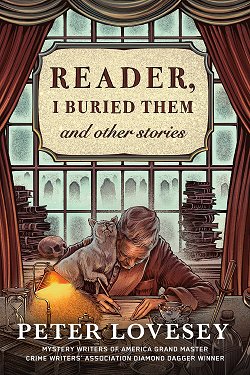
Title: Reader, I Buried Them & Other Stories
Short Story Anthology
384 pages
 
*Upcoming review on Kittling: Books.
 
Synopsis: "More than fifty years ago, Peter Lovesey published a short story in an anthology. That short story caught the eye of the great Ruth Rendell, whose praise ignited Lovesey’s lifelong passion for short form crime fiction.

On the occasion of his hundredth short story, Peter Lovesey has assembled this devilishly clever collection, eighteen yarns of mystery, melancholy, and mischief, inhabiting such deadly settings as a theater, a monastery, and the book publishing industry.

The collection includes that first story that launched his story-writing career as well as three exclusive new stories. In addition, Lovesey fans will delight in a personal essay by the author about the historical inspirations—and in an appearance by the irascible Bath detective Peter Diamond, who has, in the author’s words, “bulldozed his way” into this volume.
"  


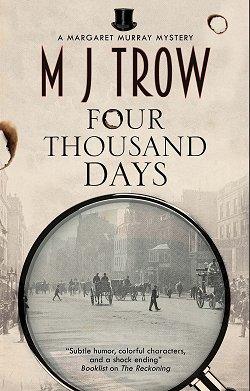
Title: Four Thousand Days
Author: M.J. Trow
Series: #1 in the Margaret Murray historical series set in 1900 London.
224 pages
 
*Upcoming review on Kittlng: Books.
 
Synopsis: "October, 1900. University College, London. When the spreadeagled body of one of her students is discovered in her rented room shortly after attending one of her lectures, Dr Margaret Murray is disinclined to accept the official verdict of suicide and determines to find out how and why the girl really died.

As an archaeologist, Dr Murray is used to examining ancient remains, but she’s never before had to investigate the circumstances surrounding a newly-dead corpse. However, of one thing Margaret is certain: if you want to know how and why a person died, you need to understand how they lived. And it soon becomes clear that the dead girl had been keeping a number of secrets. As Margaret uncovers evidence that Helen Richardson had knowledge of a truly extraordinary archaeological find, the body of a second young woman is discovered on a windswept Kent beach – and the case takes a disturbing new twist …
" 


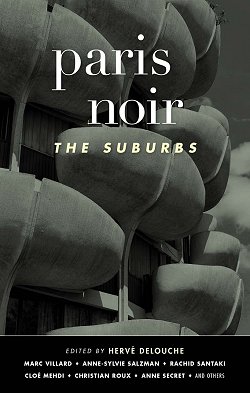
Title: Paris Noir: The Suburbs
Editor: Hervé Delouche 
Short Story Anthology set in the suburbs of Paris, France. 
280 pages

Synopsis: "From the introduction by Hervé Delouche: The term Greater Paris is in vogue today, for it has an administrative cachet and seems to denote a simple extension of the capital—as if a ravenous Paris need only extend her web. However, it was not our goal to embrace the tenets of the metro area’s comprehensive plan, aka the Grand Projet, envisioned as a future El Dorado by the planners and developers. Rather, our aim was to depict the Parisian suburbs in all their plurality and diversity. Without pretending to encompass every spot on the map, we instead opted to give voice and exposure to the localities chosen by the writers who have been part of this adventure. Thus, we decided to adopt the word “suburbs”— in the plural, obviously, for the periphery of the capital is not a homogeneous bloc, nor is it reducible to a cliché like “the suburban ring” . . . Here are thirteen stories, decidedly noir, to be savored without sugar or sweetener."
 
 
Title: The Goodbye Coast
Author: Joe Ide
Series: Standalone Philip Marlowe mystery set in present-day Los Angeles.
320 pages
 
Synopsis: "The seductive and relentless figure of Raymond Chandler’s detective, Philip Marlowe, is vividly re-imagined in present-day Los Angeles. Here is a city of scheming Malibu actresses, ruthless gang members, virulent inequality, and washed-out police. Acclaimed and award-winning novelist Joe Ide imagines a Marlowe very much of our time: he’s a quiet, lonely, and remarkably capable and confident private detective, though he lives beneath the shadow of his father, a once-decorated LAPD homicide detective, famous throughout the city, who’s given in to drink after the death of Marlowe’s mother.
 
Marlowe, against his better judgement, accepts two missing person cases, the first a daughter of a faded, tyrannical Hollywood starlet, and the second, a British child stolen from his mother by his father. At the center of The Goodbye Coast is Marlowe’s troubled and confounding relationship with his father, a son who despises yet respects his dad, and a dad who’s unable to hide his bitter disappointment with his grown boy. 

Steeped in the richly detailed ethnic neighborhoods of modern LA, Ide’s The Goodbye Coast is a bold recreation that is viciously funny, ingeniously plotted, and surprisingly tender.
" 


=== February 8 ===


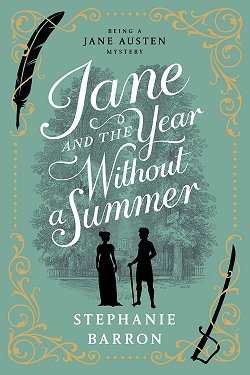
Title: Jane and the Year Without a Summer
Series: #14 in the Jane Austen historical series set in England.
336 pages
 
Synopsis: "May 1816: Jane Austen is feeling unwell, with an uneasy stomach, constant fatigue, rashes, fevers and aches. She attributes her poor condition to the stress of family burdens, which even the drafting of her latest manuscript—about a baronet's daughter nursing a broken heart for a daring naval captain—cannot alleviate. Her apothecary recommends a trial of the curative waters at Cheltenham Spa, in Gloucestershire. Jane decides to use some of the profits earned from her last novel, Emma, and treat herself to a period of rest and reflection at the spa, in the company of her sister, Cassandra.
 
Cheltenham Spa hardly turns out to be the relaxing sojourn Jane and Cassandra envisaged, however. It is immediately obvious that other boarders at the guest house where the Misses Austen are staying have come to Cheltenham with stresses of their own—some of them deadly. But perhaps with Jane’s interference a terrible crime might be prevented. Set during the Year without a Summer, when the eruption of Mount Tambora in the South Pacific caused a volcanic winter that shrouded the entire planet for sixteen months, this fourteenth installment in Stephanie Barron’s critically acclaimed series brings a forgotten moment of Regency history to life.
" 


=== February 15 ===


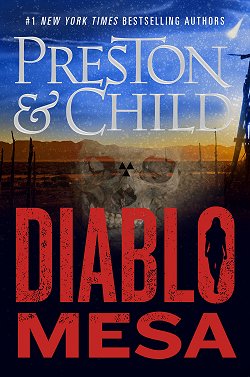
Title: Diablo Mesa
Series: #3 in the Nora Kelly series set in Roswell, New Mexico.
400 pages
 
*Upcoming review on Kittling: Books.
 
Synopsis: "Lucas Tappan, a wealthy and eccentric billionaire and founder of Icarus Space Systems, approaches the Santa Fe Archaeological Institute with an outlandish proposal—to finance a careful, scientific excavation of the Roswell Incident site, where a UFO is alleged to have crashed in 1947. A skeptical Nora Kelly, to her great annoyance, is tasked with the job. 

Nora's excavation immediately uncovers two murder victims buried at the site, faces and hands obliterated with acid to erase their identities. Special Agent Corrie Swanson is assigned to the case. As Nora’s excavation proceeds, uncovering things both bizarre and seemingly inexplicable, Corrie’s homicide investigation throws open a Pandora's box of espionage and violence, uncovering bloody traces of a powerful force that will stop at nothing to protect its secrets—and that threatens to engulf them all in an unimaginable fate
." 


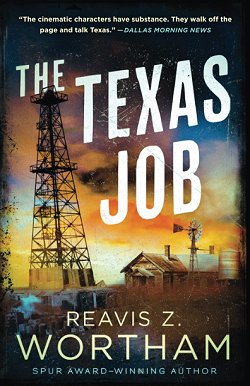
Title: The Texas Job
Series: #9 in the Red River historical series, a prequel featuring Tom Bell in 1930s Texas.
416 pages
 
*Upcoming review on Kittling: Books.
 
Synopsis: "Texas Ranger Tom Bell is simply tracking a fugitive killer in 1931 when he rides into Kilgore, a hastily erected shanty town crawling with rough and desperate men―oil drillers who've come by the thousands in search of work. The sheriff of the boomtown is overwhelmed and offers no help, nor are any of the roughnecks inclined to assist the young Ranger in his search for the wanted man.

In fact, it soon becomes apparent that the lawman's presence has irritated the wrong people, and when two failed attempts are made on his life, Bell knows he's getting closer to finding out who is responsible for cheating and murdering local landowners to access the rich oil fields flowing beneath their farms. When they ambush him for a third time, they make the fatal mistake of killing someone close to him and leaving the Ranger alive.

Armed with his trademark 1911 Colt .45 and the Browning automatic he liberated from a gangster's corpse, Tom Bell cuts a swath of devastation through the heart of East Texas in search of the consortium behind the lethal land-grab scheme." 
 
 
Title: The Secret in the Wall
Author: Ann Parker
Series: #8 in the Silver Rush historical series set in 1880s San Francisco, California.
400 pages
 
*Upcoming review on Kittling: Books.
 
Synopsis: "Inez Stannert has reinvented herself―again. Fleeing the comfort and wealth of her East Coast upbringing, she became a saloon owner and card sharp in the rough silver boomtown of Leadville, Colorado, always favoring the unconventional path―a difficult road for a woman in the late 1800s.

Then the teenage daughter of a local prostitute is orphaned by her mother's murder, and Inez steps up to raise the troubled girl as her own. Inez works hard to keep a respectable, loving home for Antonia, carefully crafting their new life in San Francisco. But risk is a seductive friend, difficult to resist. When a skeleton tumbles from the wall of her latest business investment, the police only seem interested in the bag of Civil War-era gold coins that fell out with it. With her trusty derringer tucked in the folds of her gown, Inez uses her street smarts and sheer will to unearth a secret that someone has already killed to keep buried. The more she digs, the muddier and more dangerous things become.

She enlists the help of Walter de Brujin, a local private investigator with whom she shares some history. Though she wants to trust him, she fears that his knowledge of her past, along with her growing attraction to him, may well blow her veneer of respectability to bits―that is, if her dogged pursuit of the truth doesn't kill her first." 


=== February 22 ===


Title: The Kill of It All
Series: #9 in the Madison Night "Mad for Mod" cozy series set in Texas.
280 pages
 
Synopsis: "Madison Night’s star is on the rise. Thanks to a series of TV spots to promote her decorating business’s grand reopening, she’s busier than ever. The police commissioner, impressed with her screen presence, engages her to replace the original actress in his feel-good campaign for local law enforcement. But when the first spokeswoman’s body is found on set after Madison’s testimonial airs, the last thing the police need is publicity.

Madison steers clear of the controversy by focusing on her company relaunch, but when gossip links the victim to someone special in her life, she gets involved by proxy. She uses her soapbox to draw out suspects, but if she’s not careful, it might serve as a coffin instead.

Can Madison reveal a hidden killer before the bubble bursts on her newfound success?
"
 
 
Title: The Verifiers
Author: Jane Pek
Series: #1 in the Claudia Lin amateur sleuth series set in New York City
368 pages
 
Synopsis: "Claudia is used to disregarding her fractious family’s model-minority expectations: she has no interest in finding either a conventional career or a nice Chinese boy. She’s also used to keeping secrets from them, such as that she prefers girls—and that she's just been stealth-recruited by Veracity, a referrals-only online-dating detective agency. 
 
A lifelong mystery reader who wrote her senior thesis on Jane Austen, Claudia believes she's landed her ideal job. But when a client vanishes, Claudia breaks protocol to investigate—and uncovers a maelstrom of personal and corporate deceit. Part literary mystery, part family story, The Verifiers is a clever and incisive examination of how technology shapes our choices, and the nature of romantic love in the digital age.
"

 
February is filled with favorite authors. Are any of these books on your own wish lists? Which ones? Inquiring minds would love to know!

Wednesday, July 17, 2019

Juliet Grames at The Poisoned Pen!


When I heard that Stephanie Barron (AKA Francine Mathews) would be interviewing author/editor Juliet Grames at The Poisoned Pen, I knew Denis and I would have to go. I've seen both women before at Poisoned Pen Conferences and Left Coast Crime when it was here in Phoenix, so I knew we were in for a treat. I just didn't know how delicious the treat would be! I'd always known Juliet in her role as editor for Soho Press, so seeing her as a writer being interviewed by one of her authors was a must-see.

I'm going to skip the chatter and head straight for the interview. I record them now which means not only can I share more of the interview verbatim with you, but also I can enjoy myself more during the event because I'm not scribbling furiously every second. Let's get started!


Don't you just love it when someone tall comes in at the last second and sits in front of you? Stephanie Barron (left) and Juliet Grames (right)


Barbara Peters: Good evening, everyone. Thank you for coming out. I always encourage you to come and meet debut authors because then you will have bragging rights forever, right, in case they turn into a bestseller or a critical hit. The hilarious part of this is that the three of us have known each other for years. She's an editor at Soho which is part of Penguin Random House. Francine, AKA Stephanie Barron, has published many books with Random House, and now I am an editor at Random House. It's just really amazing how it's all worked out.

Anyhow, that's not the point of the evening. Francine and Juliet are here to discuss Juliet's book and also turn the tables and find out what it's like for an author to grill an editor. I'm going to pass around cookies, sit down over here and enjoy it!

Stephanie Barron aka Francine Mathews
Stephanie: I'm so glad all of you joined us tonight because Juliet is one of my favorite people in the world. She is, as Barbara said, my editor. She has edited my Jane Austen mysteries as well as supervised the revision of my entire Nantucket series.

Juliet and I have worked a lot together. One of the reasons I was so thrilled to find her and have her agree to take me on as a writer is because she actually edits. Those of you who know book publishing won't be surprised to learn that many of the people in New York in publishing are focused on acquiring books but not necessarily on actually editing them. I'm glad that she's getting the hot property treatment and I'm looking forward to having her talk about it. Juliet was the hot property with Stella Fortuna about a year ago and had a dizzying experience with the sale of her first manuscript.

Juliet: It's still pretty dizzy! [audience laughter]

Stephanie: What I love about Juliet's editing is that she's extremely thoughtful and very well versed in the canon of English literature. She's deeply interested in character development... and all these things I've experienced as a writer being edited by Juliet are amply in evidence in her first novel, The Seven or Eight Deaths of Stella Fortuna. Fascinatingly, when I first started working with Juliet, I didn't know that she was a writer as well. It's unusual, obviously, to wear both hats because they're both so time-consuming. Juliet is also an associate publisher at Soho which means that she's responsible for so much of the running of the company.

She mentioned at one point-- I think we were at a bar-- that she was finishing her novel, and I was blown away. Then I learned that the woman who is now my editor at Random House-- because I have editors at both houses-- in fact tried to buy Juliet's book. So it's that sort of six degrees of separation. So, Juliet, if you could, I know you've done this quite a bit because I've seen you on video doing this... if you could explain a bit about your inspiration for Stella Fortuna and how you were compelled to write the book we have sitting here in front of us today.

Juliet Grames
Juliet: Sure, and thank you for your very generous introduction. I hope I deserve all that!

The Seven or Eight Deaths of Stella Fortuna is a novel about two sisters. When we meet them, they're about one hundred years old, and they've been locked in a blood feud for about thirty years. The book purports to go back to the beginning of their lives in a tiny village in southern Italy and unpack what made them go from being best friends to bitter enemies. It tells the hundred-year life story of these sisters, their feud, and specifically the main character of Stella who has really bad luck and lots of near-death experiences.

I come from a very tight-knit Italian-American family. You can see that my parents and baby are here. They traveled from two states on the East Coast in order to be here, so we're just a very tribal people. A lot of Italian families are very tight-knit. My grandmother was, in fact, an immigrant. She came over in the 1930s when she was a teenager. The core relationship between the two sisters was inspired by her and her sister. They were very involved in my childhood. They took care of me when my parents were working before I went to kindergarten. They were a huge part of my life.

When I was five years old, my grandmother had a brain injury that ended in a life-saving lobotomy. She lived an additional thirty years after the lobotomy, but it completely changed her personality and caused this terrible feud with her sister that no one ever understood. I used that heartbreaking family schism as a jumping-off point to unpack the Italian-American immigrant story. I was really fascinated by the region of southern Italy that they came from-- Calabria, which I found very difficult to read about because there's not a ton written about it, so I really wanted to put down something in text for other people to know more. And also to collect some of the lore from other immigrant families who'd come over to live in the Hartford area where my family settled. Those were my two aims. One, to try to represent the Calabrian experience, and two, to honor my grandmother and the lost person she was before this accident that completely changed her personality.

Stephanie Barron
Stephanie: That leads me to a question that kind of haunted me as I read the book, and that is how closely your fictional account is to the actual events in Stella's life, which I know wasn't your grandmother's name, but for the sake of simplicity let's call her Stella.

Juliet: The biggest problem for me in writing this book... I've told many writers whom I've worked with as an editor that when you hit a wall with your story, follow the character. The character will get you through. You should write from character to plot and not the other way around.

In this case, trying to follow the beats of my grandmother's life story and make things hit like the facts actually happened was so hard because I didn't understand the character. My grandmother was a cipher to me. She had had part of her frontal lobe removed, so I had to decide what bits of her actual life I could use and actually understand why they happened. In the end, that ended up being the eight near-death experiences. So those are all fact. My grandmother had eight near-death experiences. Everything in between those deaths is fiction, and especially the character of Stella is fictitious because I don't know who my grandmother was as a young woman. The facts are lost or eroded by the thirty years that followed the accident. She was a person who needed to be cared for-- a burden-- although we loved her and took care of her... my family did an amazing job keeping her alive and taking care of her during that time. Still... you forget, so the deaths are real and the rest is completely invented.

Stephanie: Okay, so that leads me to a question because, having written myself about people who actually lived-- which I do a great deal-- in my work, there's always a moment where you have to step across a line in the sand, which is what you know about the character and what you decide to own and create about the character. Make that actual person your functioning guide through a story. For me, I've always had to identify a moment of vulnerability in that person. Usually, it's a moment in childhood that scars them or defines them and slightly bends the nature of their personality as they move forward through life. That gives me a handle on them.

Juliet Grames
Juliet: That sounds very realistic to me!

Stephanie: Well, I'm interested because you know about the eight near-deaths and yet you say that you know very little about who she was. Yet the character of Stella in the book is such a strong woman, and she's strong against the backdrop of everyone around her. She is a distinctly defined personality whereas her mother, her sisters, her brothers, her father seem to fall into more generalized patterns. Not that they aren't distinct characters. The sister who's so close to her is a very biddable girl. She doesn't strike out on her own, she's a follower... but Stella is such a distinct persona that I felt like this was your grandmother. I'm interested in the choices you made and how you made them to create that person out of what you've suggested was a void.

Juliet: Part of it was imagining, but I have to be honest with you. I've never felt like a very creative person. I don't think I'm good at coming up with things from scratch. At heart, I'm sort of the history major type, and when I was really at a loss for a thing would have happened in the plot, my solace was usually research. The more I read about topics, the more I would find the arcane points, especially the women's lives that don't always make history books that would have vastly affected a day-to-day scenario.

When I was probably in fourth grade, my grandmother came to school to talk to my class about her immigration process. We were talking about where we had come from. She gets up in front of the class. My mother had come with us in case she needed to translate if my grandmother became confused and spoke the wrong language. So in front of the class, my grandmother starts talking about worms. My teacher redirected her because it was incoherent. So we talked about what it was like to go to Napoli to catch the boat, the Statue of Liberty, and New York Harbor. When we got home, my mom said, "Ma, why were you talking about worms?" My grandmother said, "You wanted to ask me about what my life was like in Italy, so it was about these silkworms." and we're all like, "What?!? Silkworms are from China. Everyone knows that!" Then my mother went to ask my great-aunt who said, "Oh yeah. When we were little, it was our only source of income. We raised silkworms all summer long." This is a totally lost art because, after World War II, it all went to the factories in the north.

Available Now!
In these remote villages-- in Calabria especially-- peddlers would come to these mountain villages, they would sell these pouches of eggs which the women would tie under their dresses against their bosom. When the eggs hatched, they would spend twenty-four hours a day for the life cycle of the worm feeding them mulberry leaves-- which needed to be harvested. It's a very demanding process that takes up a month of the year. This is how they saved up money to buy their trousseaux which were the only things they ever had in their lives. They're not allowed to own land; only the men could own land. Women are not citizens so they can't have bank accounts or income. They can only work for in-kind payment like a bottle of olive oil.

But suddenly when you understand that probably all the women in this village during the month of July are operating in a kind of fever trance of sleeplessness because they're trying to make their income for the year, it makes it much more likely that you're to have a near-fatal accident when you're not watching your child and they get into something like boiling oil. This is just one kind of extreme example, but more I learned about life and these little tiny details, the more the plot organically clicked into place. There's usually a historical explanation for why something weird happened, you just have to keep digging.

Stephanie: I completely agree with you. I think it has always been the research that has both compelled me to write a story... usually I'm interested in something and I start reading about it and peeling back the layers of the onion, and then I come to the story that is calling me to write it. That's the great gift of loving history, I think.

Juliet: This is why we like each other. [audience laughter amid the mutual agreement]

Stephanie: The arc of the story is fundamentally that Stella's childhood in Italy is radically changed by immigrating to New York and then Hartford, Connecticut, and her immersion in a new culture. You've woven that against a backdrop of a somewhat tortured romance. I was curious about your choices with that.

Juliet Grames
Juliet: That romance was an invention. But that was one of those things that came out of asking myself why. I knew I had to get her from Point A to Point B, and the more I dug into her character, the more I understood about her attitudes toward romance and marriage and sex. I would love to say more, but I don't want to spoil anything, so let me self-censor here a little bit.

I think that if you're growing up in the world Stella is, which is the 1920s, in extreme Catholic patriarchy... it's not the modern Catholic Church. The southern Italian Catholic Church, in particular, was deeply affected by four hundred years of  Spanish colonialism which was extremely exploitative. The Church is not just the church we think of, it's also the fact that it owns 80% of the land. So most people are essentially feudal slaves working for the Church, albeit through a middle man who collects a fee. Things like sex and social mores become so binding and grinding. There is no freedom anywhere you go. You don't have the power to work for yourself. I think you get a system where men are... yes, they are empowered over women-- they own their wives and their children, the wives have no personhood-- but the men own nothing else. They toil for sixteen hours a day in these miserable conditions, and often at the end of the year there's not enough money left over to pay for medicine for their children. There's just misery on every side because of this exploitative system developed under the Spanish rule.

If you're a very very good man, maybe you survive that by being a good husband and father, but if you have any personality damage done by four years of terrifying war experience or any other number of hardships that befell this generation, you may go home and take out your anger on your wife. What you may see here are a lot of demented family structures. The men are exploited by this system and then they turn around themselves and exploit. I think if you're a woman who has absolutely no power in this situation other than over her own sexuality, that's the one thing you get to hold onto. Stella sees her one path to freedom as not ever having to subject herself to a man.

Stephanie Barron
Stephanie: I found this fascinating because you chose, in writing this book, to insert yourself as a narrator so the book feels very much as though it bridges both fact and fiction. You allow readers to feel as though you are the granddaughter in the story-- and you are to a certain degree-- but also that you are our guide to this world which you created.

Juliet: I did a ton of book research. I wrote the second half of the book first because I felt that I knew it well enough. Meanwhile, I was reading everything I could on Calabria and the south in general. In English and Italian-- which I had to learn for this project. There's just so little written history. Because of the Spanish colonialism, Calabria was basically an illiterate region until the 1920s. Until recently no one was writing their own stories. Now they are, but it's about the Mob, which is a shame because there are a lot of other stories.

I got what I could out of books but ultimately the real research was in going back to my grandmother's village. I took a leave of absence from work and I lived there in the house she grew up in which is now owned by a second cousin who is a retired postman. It was really neat! The first time I met him, I was on an exploratory vacation trip, and he said, "Oh, this is your house, too. You must come and live here for a minimum of one month!" [audience laughter] He meant it, and it was great. He found out relatively early in my stay that I loved the proverbs he shared which are a huge part of Calabria's culture. It's their way of making everything funny.

He'd be taking me around. We'd be meeting people and collecting their histories. I had my tape recorder and I'd have interviews with old people, but the first thing before we sat down, he would say to them, "Tell us your favorite proverbs" and I would write them down in my notebook. By the end of my stay, I had 130 of them. I only got to use twelve in the book, but I'm saving those others! [audience laughter]

Barbara Peters. Juliet's mother is behind her.
Stephanie: Can you share some of them with us?

[Juliet would first say the proverb in Italian then repeat it in English. Want to see and hear this? Check out the event on The Poisoned Pen's Youtube channel!)

Juliet: "The old wolf loses its fur but not its wiles," which I think is great. Another one which is funny or not funny depending on how you're interpreting it is "Which do you want, the full bottle of wine or the drunk wife?"

Stephanie: Oh man, what a choice!

Juliet: These are important cultural, sociological research things that I got a lot of Calabria's character from. It was hard to actually work them in. Something else that I gathered during my time there doing research was folk songs. I learned so much folk music while I was there.

Stephanie: Which is a theme in the book.

Juliet: It is a theme in the book, but it's so hard to work everything in. There's only one song that's actually in the text which is kind of like Calabria's national anthem as I call it--"My Beautiful Calabrese Girl." It so matched the theme of the book, and the tune got stuck in my head, so it sort of wrote itself into the story. Can I sing a little of it?

Stephanie: Oh, please! [audience agreement]

Juliet sang the song in Italian, and after a verse or two, her mother, who was sitting in the audience, joined in. It was so beautiful that tears came to my eyes, and I've since learned that I wasn't the only one who had an emotional response to the song. Please... watch (and listen) to it! The song begins around the 24-minute mark.

Juliet Grames
[audience applause]

Stephanie: I have to commend you because part of the time I was reading The Seven or Eight Deaths of Stella Fortuna, I was actually listening to it on Audible, and of course, the narrator does not know how to sing that song. It's interesting to hear the differences between Italian and Calabrese.

Juliet: They are very different. Calabrese is called a dialect, but I think that's disrespectful. Just because it's not a written language, it is a language. It's full of classical and Byzantine Greek, there is a ton of Arabic. There is a ton of Albanian, and of course, Spanish.

Stephanie: I want to get back to your choice to insert yourself as a narrator, why you felt it was important to frame the book with your voice.

Juliet: Because Stephanie, we can't all do what you do! I have the very highest respect for actual historical fiction writers because what you have to do is pick your period and your theme and then stick with it and actually tell the story staying within the rules of that time period. I just couldn't do it because there were so many things I wanted to say that would not have been native to Stella's point of view. I did try to write this in first person from Stella's point of view, but I realized that I was leaving so much in the margins of the text that was making me angry to leave out. So a very modern fictional narrator began to interpolate, and I just let her stay.

Stephanie: Did you ever consider framing the book differently?

Juliet: No! [audience laughter] You mentioned that you didn't know I was writing when we first met, and at first I was really gunshy about confessing to anyone in my publishing life or wider life that I was writing because if it didn't go well, I thought it would be not only embarrassing for me but maybe reflect poorly on my career as an editor.

Juliet Grames
During the tortured years of writing this book-- because I think all the years of writing any book are torture [audience laughter]-- but in this particular situation, I had some beta readers and even an early agent read... I sent it to the person I thought would really like it and then she didn't like it, so I didn't show it to anyone else for about two years.

Stephanie: So what you were hearing was publishing's conventional wisdom...

Juliet: Yep!

Stephanie: ...about how you structure a story...

Juliet: Yep!

Stephanie: ...and yet you as an editor... bought that, and that's interesting.

Juliet: I think now, in retrospect-- and I should have known better, I've been in publishing for fifteen years-- but I think a lot of agents are looking for things... agents only make 15% of the sale-- so often they are looking for books that remind them of ones that have done well. So if you're doing something very different, it becomes harder to see how you're going to position it. On the flip side, I think editors are bored by seeing the same things over and over again, so I think they wanted the thing that didn't remind them of what they'd already seen before. My advice to aspiring authors is don't give up. The agents were the most difficult part of my publication process, but I think that's the case for many people.

I also think that if you know what your book is you should trust yourself. If it turns out that your book is only for five people, that's fine. [audience laughter]

Stephanie: Wow. That goes against everything any writer is told on a daily basis.

Juliet: Now I'm going to wear my editor hat. When I edit authors, I hope I never tell them that they're telling the wrong story or that they're telling it in the wrong way. And if that does happen, it makes me wonder if maybe we shouldn't be working together because we don't have a similar vision for the book.

Juliet Grames
I don't have the arrogance to think that what I like to read is what everyone likes to read. I think this is why we're surrounded by so many different genres right now. There are readers who are looking for different things. I think if you're a writer, you have to stick to your guns about what you want to say. I knew what I wanted to say.

Stephanie: How did you, as an editor who probably has to submit to market considerations, how you were willing to buck market considerations to a certain degree in writing your own book?

Juliet: I'm never willing to submit to market considerations which is maybe why I work at an independent press. [audience laughter] I know. I can't. As a reader, I don't want to read things that remind me of other things. I think everyone should be free to follow their hearts. [audience applause]

Stephanie: The counterpoint to this is that most large publishing houses are governed, not by editing, but by their marketing departments, and the marketing departments are focused on whether you have a platform on social networks that you can use to sell your books. They are obsessed with that. Your reach, your followers... it's all done by the writers now. It's highly unusual-- and you usually find this only in smaller publishing houses-- the willingness to allow writers to follow their hearts.

One last question: what are you thinking of focusing on next besides your beautiful baby, Carlos?

Juliet: In my research for this book, I found that villages are so remote and disconnected in Calabria during this period that you could find all this interesting information about another Calabrese village that has absolutely nothing to do with the world you're writing about, which was a great disappointment-- because I found some amazing content-- but I also found inspiration for another book! So that's where I'm at.

As you may know, I'm a crime fiction editor at Soho and that's what brings me here today via that connection. I'd like to write a crime novel after carefully studying the form for ten years, so we'll see if I can pull it off! [audience laughter] It's really hard to plot responsibly! I'm writing a book set in the 1960s in the very deep south of Calabria in a mountain range that's home to the Calabrese mob. They are one of the largest and most heinous crime syndicates in the world, and they've really flown under the radar.

I will tell you that I did drag my very good sport mother on a two and a half week exploratory tour of these Mafia villages in Calabria during the summer of 2017.


After a short Q&A session, the event was over. What a fun and informative evening-- just as I knew it would be. I wish all of you could go with me to The Poisoned Pen-- it's a little slice of heaven for book lovers!


Monday, March 25, 2019

That Churchill Woman by Stephanie Barron


First Line: Sunlight streamed like wings through the chapel's clerestory windows.

History isn't always kind to the women who give birth to great men. Winston Churchill is the man who defined the twentieth century, and it's safe to say that many of his early biographers would have preferred to ignore his parents completely. Winston's father, Lord Randolph Churchill, was a promising politician who died of syphilis, but that was easier to cover up and ignore than Winston's mother, American heiress Jennie Jerome.

Artistically gifted, athletic, and politically astute, Jennie lived her life with passion and just the way she wanted to, which was definitely not to the liking of the male biographers of Winston's day. No, indeed. Those biographers would have much preferred Sir Winston to have sprung fully formed from the forehead of Zeus.

All this means that Jennie Churchill has been given short shrift over the past century, but no more. Author Stephanie Barron's elegant, in-depth research shows this extraordinary woman in all her beauty, courage, intelligence, and unbelievable loyalty. Barron does a wonderful job of laying bare Jennie's motivations and choices, and the important part her father, Leonard Jerome, played in her life.

Since Jennie has not received fair treatment from biographers over the years, Barron is very carefully even-handed in her portrayal of her. Readers see the questionable, the contradictory, as well as the good. The author wants readers to form their own opinions about this remarkable woman, and although I appreciated not being told how to feel about Jennie, I felt Barron's approach was a bit too careful, a bit too even-handed. The book felt a bit dispassionate, which stripped some of the color from the narrative, and the characters failed to fully come to life for me.

If you're an Anglophile with any smidgeon of interest in Winston Churchill, his family and formative years, read That Churchill Woman. If you enjoy biographical fiction about strong, extraordinary women, read That Churchill Woman. It may not have quite met my expectations, but it's still an excellent read. How would Jennie react? With one word, I think: "Finally!"


That Churchill Woman by Stephanie Barron
ISBN: 9781524799564
Ballantine Books © 2019
Hardcover, 400 pages

Biographical/Historical Fiction, Standalone
Rating: A
Source: Purchased at The Poisoned Pen.