Showing posts with label Naval History. Show all posts

Monday, April 17, 2023

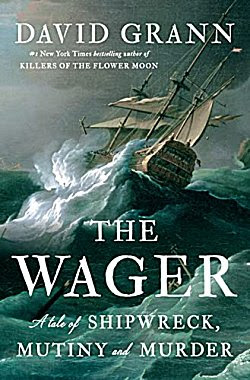
The Wager: A Tale of Shipwreck, Mutiny and Murder by David Grann

 
First Line from the Prologue: The only impartial witness was the sun.
 
In January 1742, a dilapidated boat carrying thirty men who were barely alive washed ashore on the coast of Brazil. They were survivors of the shipwrecked HMS Wager, part of a flotilla of British ships sent to war on the Spanish. The Wager had wrecked on an island in Patagonia after an unsuccessful attempt to round Cape Horn. After being marooned for months with little shelter or food, these men managed to piece together a boat and set out on a 3,000-mile journey that took over one hundred days. They were hailed as heroes.

Six months later, an even more decrepit craft landed on the coast of Chile. The three castaways aboard this boat had a very different tale to tell: those thirty men in Brazil weren't heroes, they were mutineers.

When all the survivors returned to England, accusations flew thick and fast. The alleged mutineers told of a captain not fit for duty-- a captain who shot and killed a fellow crew member with no warning whatsoever. When the Admiralty convened a court-martial, there was a lot more that had to be settled than the mere loss of a ship, and whomever the court found guilty would hang.

~

David Grann is one of my favorite authors, and his Killers of the Flower Moon is one of my all-time favorite non-fiction books. Since I have an interest in maritime history, I knew I had to read The Wager, which describes one of the longest castaway voyages ever recorded.

Grann set the stage so well that readers feel as though they're on board ship with the officers and crew. This was the time of press gangs when the British Navy had so much trouble finding enough sailors to man their ships that they'd send groups of men to roam the streets outside pubs at night to kidnap men and force them aboard ships for duty that could last years. This meant that not all the men on the Wager wanted to be there. As the voyage progressed, scurvy set in, and as men began to die, the Wager found itself with a new captain named Cheap, a man who would be called "Jobsworth" by the British (as in it was more than Cheap's job was worth to go against his orders). Cheap's bungling and indecision were instrumental in the Wager's unsuccessful attempt to round Cape Horn, ending with the ship being wrecked and the survivors being castaways on a desolate island in Patagonia. This isn't the first book I've read about the land, the seas, and the weather of the Tierra del Fuego, but Grann wrote of it so well that I felt seasick, wet, and frozen solid as I turned the pages. The months the castaways spent on that island, trying to survive and trying to escape, were brutal.

Grann immersed me in these men's lives-- one of whom would be the grandfather of the poet, Lord Byron. (Yes, Byron's experiences were important in light of one of his descendants, but the crew member who had the most impact on me was the free Black man on the Wager, John Duck.) Grann also reminded me of the integral part sailors played in the history of our clothing and our language. However, the one thing that I enjoyed the most was how he exposed what was really going on and how the Wager's original assignment and the proceedings of the court martial at the end actually fit into the much larger world stage. 

Any reader with an interest in ships, the sea, human nature, and government machinations should read The Wager.

The Wager: A Tale of Shipwreck, Mutiny and Murder by David Grann
eISBN: 9780385534277
Knopf Doubleday © 2023
eBook, 352 pages
 
Non-Fiction, Standalone
Rating: B+
Source: Net Galley

Wednesday, February 23, 2022

Halsey's Typhoon by Bob Drury & Tom Clavin

 
First Line from Preface: Chief Quartermaster Archie DeRyckere was more astonished than frightened.
 
Even the most popular and victorious admiral in the U.S. Navy can make mistakes. Charged with defending General MacArthur's flank during the invasion of the Philippine island of Mindoro with his 30,000-man Third Pacific Fleet, Admiral William "Bull" Halsey attempted a complicated refueling maneuver and sailed 170 ships straight into the teeth of a massive typhoon.
 
Men and ships found themselves battling 90-foot waves and 150 mph winds. Three ships were sunk, and almost 900 sailors and officers were swept into the Philippine Sea. For three days, survivors battled the weather, dehydration, exhaustion, and sharks. Ultimately, it was up to Lieutenant Commander Henry Lee Plage to defy orders and sail the badly damaged USS Tabberer back into the storm to rescue the drifting sailors.
 
~
 
I would imagine the first question is why this crime fiction lover chose to read a book about a tragedy at sea during World War II. The answer is simple: my grandfather. My grandfather served in the US Navy aboard an LST in the South Pacific during World War II. He drove landing craft up on the beachheads and also served as an anti-aircraft gunner. He was very tight-lipped about his service, only mentioning three things. One of them was being caught in a typhoon and how everyone aboard was well beyond being merely seasick. When I read the synopsis of Halsey's Typhoon, I wondered if this could be the typhoon my grandfather mentioned. 

When I finished reading the book, I did a little research and compared some dates. This wasn't the typhoon my grandfather mentioned, and for that, I am eternally thankful. What I couldn't foresee was how emotionally involved I would be as I read Halsey's Typhoon. Of course, I learned things. What makes a typhoon in the Pacific deadlier than a hurricane in the Atlantic. How ships were refueled at sea. I learned about ship design and how retro-fitting some of the old destroyers in the Pacific Third Fleet sealed their doom during the typhoon. (Stay away from top-heavy ships.) I also gained respect for a future president who survived this tragedy.
 
Authors Bob Drury and Tom Clavin gave us readers Halsey's background, they set the scene, they let the typhoon bludgeon us then cast us adrift in rough seas with no water and no protection from the sharks before letting us be rescued. Reading this book was sometimes exhausting. I was completely emotionally invested in Halsey's Typhoon. I grew to know the men, to care about what happened to them. I was a nervous, seasick wreck during the horrendous typhoon. I cried as the ships sank and men-- most of them barely out of their teens-- desperately tried to save themselves. And my heart swelled when the commander of the badly damaged USS Tabberer defied orders in order to continue to search for and rescue survivors. As far as I'm concerned, there would never be enough medals to give Lieutenant Commander Henry Lee Plage. 

When all is said and done, what was at the heart of this hushed-up disaster? I think it can be summed up in one sentence from the book: "Meteorology was not high on the U.S. Navy's list of wartime priorities." That is not wise when you're responsible for thousands of men aboard hundreds of ships traveling vast expanses of water that are at the mercy of the weather.
 
Halsey's Typhoon is a brilliantly written piece of wartime naval history that reads like the best fiction. I couldn't put it down. 

Halsey's Typhoon: The True Story of a Fighting Admiral, an Epic Storm, and an Untold Rescue 
eISBN: 9781555846299
Atlantic Monthly Press © 2007
eBook, 414 pages
 
Non-Fiction, Standalone
Rating: A+
Source: Purchased from Amazon.